The Cost of Service in a Partisan Age

This post appeared originally at the Center for Security Policy Studies blog https://csps.gmu.edu/2019/11/09/the-cost-of-service-in-a-partisan-age/ on November 9, 2019
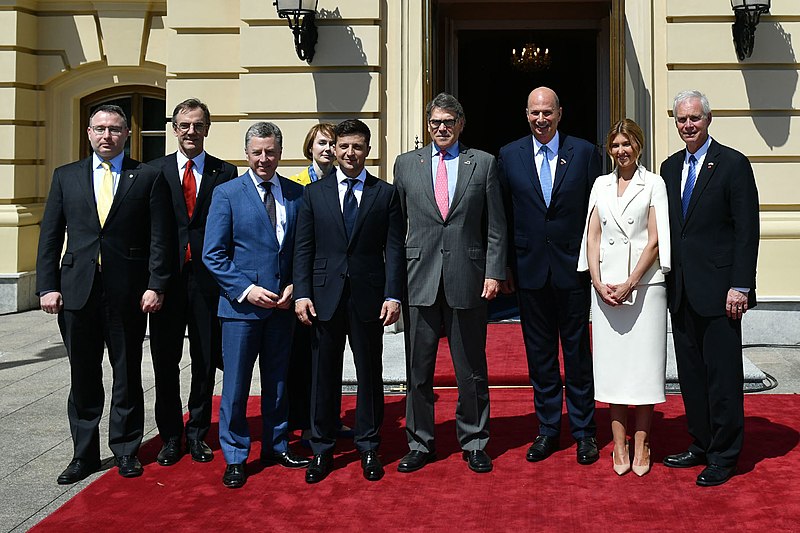
Delegation (left to right): Alexander Vindman, Joseph Pennington, Kurt Volker, Olena Serkal, Volodymyr Zelensky, Rick Perry, Gordon Sondland, Olena Selenska (First Lady), Ron Johnson at Zelensky’s Presidential Inauguration, 2019
Photo from Wikimedia Commons

The Trump administration has challenged American norms of civil-military relations. Candidate Trump signaled that he would reverse established law and attack commonly held norms when he promised to reauthorize waterboarding, and he further challenged tradition by appointing an unusual number of serving and retired generals to senior positions and referring to them as “my generals.” In this hyper-partisan environment, the military has struggled to maintain a non-partisan position. Maintaining it became unexpectedly harder last week when a serving military officer, LTC Alexander Vindman, was drawn into the impeachment inquiry, and the president subsequently attacked him personally.

Faced with this challenge, the military’s priority is to remain outside the partisan fray and maintain its position as a trusted national institution. Political actors, including the president, are attempting to use the military’s prestige to bolster their positions. This prestige, however, rests on the tradition of non-partisanship.

Decisions about when and how to go to war are inherently political because they have political consequences, but the military has traditionally provided advice on matters with political implications while scrupulously avoiding any participation, even indirectly, in the partisan contestation of elections. In a time when every question is contested on a partisan basis, every answer becomes partisan. The military must tread an extremely narrow path to fulfill its obligations without straying any further than necessary into partisan conflict.

Testifying truthfully before Congress should not be a partisan issue, but there is no way to avoid appearing partisan in modern politics. Refusing to testify is perceived as partisan by the one party; agreeing to testify is perceived as partisan by the other. Assertions that LTC Vindman could be court-martialed for testifying are far-fetched, but he has been vilified in the conservative media and will likely retire at his current grade despite his stellar credentials.

LTC Vindman’s situation presents a dilemma for military leaders attempting to sustain non-partisan norms. So far, senior military leaders have neither criticized nor defended Vindman. There are no grounds for criticizing him, but to defend him would place the military establishment in direct conflict with the president and create the appearance that the military is taking a side in the impeachment debate. For military leaders, the priority should remain protecting the military’s non-partisan legitimacy. This may, unfortunately, include tolerating unfair treatment of one of their own. Up to a point, the institutional legitimacy of the military is more important than the mistreatment of one individual.

Opponents of the president may be tempted to make Vindman into a heroic symbol of resistance. They would be wise to resist the temptation. Conservative adulation of Lt. Col. Oliver North after he testified to Congress regarding the Iran Contra Affair in 1987 reinforced the growing perception at the time that the military was closely aligned with the Republican Party, which subsequently undermined the military’s credibility and prestige. [1] 

The real test will come if the president and his supporters continue to attack Vindman publicly or attempt to take legal action against him. Retiring as a lieutenant colonel may be unfair, but it is a small price to pay for defending the norms of civil-military relations. If Vindman testifies in open hearings, the president and his supporters are likely to engage in public character assassination in order to undermine his testimony. The president has already shown his willingness to intervene directly in military legal proceedings.

Military leaders can be excused for accepting some costs to Vindman in exchange for protecting the military institution, but they cannot allow him to be prosecuted or maligned publicly by the president in a way that could make him a target. If the president pursues his standard playbook of innuendo and harassment, he will place military leaders in a lose-lose situation – either publicly contradict the president in a highly-charged partisan matter or publicly abandon an officer to be persecuted for his honorable service. The president should understand that unfounded public attacks risk reluctant repudiation by his senior military leaders, and those leaders should privately signal their willingness to do so before it becomes a public spectacle.

Senior uniformed and civilian military leaders must prioritize the military’s non-partisan integrity in a highly partisan environment, but they must realize that they risk the same dilemma as LTC Vindman. Whether he chose to testify or not, his actions were bound to be seen as partisan. Now, military leaders will face the same problem if the president forces them to choose between defending Vindman or abandoning him. The president and his supporters will view the former as partisan resistance, and Democrats will view the latter as partisan acquiescence. The president should avoid creating that dilemma, and military leaders should let him know now, before it again bursts into public view, that they too will speak truthfully and publicly if forced.

[1] Peter Feaver and Richard H. Kohn, Soldiers and Civilians: The Civil-Military Gap and American National Security (MIT Press, 2001).

Casual Lies and the Military Profession

The Wall Street Journal published an account of American soldiers fighting in Russia (paywalled) at the end of World War I to commemorate the centenary of the armistice. Leaders were unable to explain to the soldiers why they were in Archangel fighting Bolsheviks when they had been drafted to fight Germans. Things became even more tense once the Germans surrendered and supplies ran short just in time for the Russian winter.

Initially commanders did what commanders do–they assured their higher headquarters that all was going well and morale was high. It wasn’t and it wasn’t. Eventually the senior officers had to acknowledge that troops were on the verge of mutiny.

Looking back at the Polar Bear Expedition in light of yesterday’s dog and pony show on the Mexican border highlights an age old problem for militaries, one we would do well to fix. The first officer to tell his masters, uniformed and civilian, that things are going badly will almost certainly be first ignored, then relieved, and finally besmirched. Only when word gets back to the home front and politicians face angry families, or when military disaster becomes undeniable, will senior officers drop their insistence on optimism and positive news.

The WSJ story makes it clear that is what happened in Archangel. I recently rewatched A Bridge Too Far, in which the intelligence officer who predicted disaster was cashiered before the operation. Phil Klay published a brilliant reflection on his own Iraq service in America on Veterans Day that recounted the disgrace of the PSOD (read it for yourself–it is well worth the time). Finally, yesterday, we got to witness commanders on the ground assuring the Secretary of Defense, himself a distinguished combat commander, that soldiers laying wire along the Mexican border to defend the mightiest nation on earth against a few thousand tired migrants were both deriving great training value and maintaining sky-high morale. As usual, the soldiers themselves were not having it, and we are left with the uncomfortable acknowledgement that field commanders are more likely to say what their bosses want to hear than to tell the truth. That military professionals just accept this practice as a necessity of promotion (and I do not exempt myself from this criticism) says nothing very good about the military profession in America in 2018.

American soldiers are not Roman centurions and they are not the French Foreign Legion. The citizen soldiers of a democracy deserve better. Our society lavishes praise on the “heroes” who lead our military, but we collectively are not worthy of such praise if we can breezily lie when it suits us. Leonard Wong and Stephen J. Gerras identified the problem in a well-regarded paper, but senior leaders have not made fixing it a priority. We should not be surprised–everyone in a position of authority rose through the system in which casual and obvious dishonesty was required. It would be surprising if they turned on a culture that has rewarded them so greatly. The tragedy is that these are not evil men and women. In my experience, most of them are scrupulously honest in their daily lives. They do not lie to their spouses. They would not cheat on their taxes or steal a candy bar. The military has placed certain areas outside the bounds of normal rules for honesty.

We have developed a leadership culture that views positivity and optimism as fundamental characteristics of leaders, and to some extent they are. Nobody will follow a sad-sack. The danger is that it is far too easy to conflate optimism with happy talk. Telling superiors that morale is good when it is clearly not is not optimism or positive leadership–it is lying. The mutineers of Archangel showed where it leads. Secretary Mattis should never have asked a commander on camera how morale was–answering with anything short of “excellent” would have been career suicide. In asking the question, the Secretary was essentially soliciting a lie for public and presidential consumption on national television. In doing so, he signalled every uniformed leader that such casual dishonesty was not only acceptable but expected.

I should point out here that I am not assuming that morale is bad. Perhaps it is great, although I doubt it. The point, rather, is that the colonel’s answer moves us no closer to knowing the state of morale at Camp Donna than we were before the Secretary asked the question. If we ask ourselves the simple question, how would the colonel’s answer have differed if morale were good or bad, we recognize the problem. The U.S. military has been fortunate not to face an existential threat since about 1944. Since the turning points of World War II, we have faced some terrible combat at places like Chosin and Khe Sanh and Falluja, but no military leader (outside a few watch officers at NORAD) has faced a decision on which the fate of his nation hangs. Officers have been free to answer with their careers in the forefronts of their minds, knowing that the immense national power of the United States would mitigate any negative consequences. Even when troops rebelled, as they did in Archangel and on occasion in Vietnam, the consequences were unlikely to be disastrous.

Only a culture of radical honesty, fostered from the top, will overcome the cost-benefit analysis that leads officers to tell “little white lies” that in the aggregate are neither little nor harmless. When I was a young captain, my battalion commander used to say, “don’t [urinate] on my back and tell me it’s raining.” When military senior leaders start responding that way to obvious happy talk from ambitious colonels, we’ll be on the right path.