To Serve or Not to Serve

This post first appeared on the Center for Security Policy Studies blog https://csps.gmu.edu/2020/03/09/to-serve-or-not-to-serve/ on March 9, 2020.

Prospective national security professionals may be forgiven for avoiding the federal government in the current political climate. Watching President Trump, members of Congress, and cable TV personalities impugn the integrity, competence, and patriotism of  national security officials does not paint a picture of a happy, fulfilling career. Disapproval of administration policies, like family separation or the President’s pardoning of accused war criminals, further discourages recruiting. Nevertheless, young people with talent, integrity, and an interest in national security should pursue opportunities to serve.

National security professionals recognized early that President Trump’s approaches to both national security and the federal workforce would pose staffing challenges. Dan Drezner wrote four Washington Post columns on the subject (see here, here, here, and here). Eliot Cohen initially encouraged people to seek positions but to “keep a signed but undated letter of resignation in their desk” to remind themselves of the requirement to identify their ethical redlines and to resign if required to violate them. He quickly reversed himself after deciding the administration would make honorable service impossible. Benjamin Wittes argued senior professional staff  should stay on to ensure high quality professional advice unless ordered to do something unethical.

What has happened in the three years since these questions began circulating?

Nothing good.

The number of applicants taking the Foreign Service exam dropped by 34% in 2017 and a further 22% in 2018. President Trump appointed a high percentage of political supporters to ambassadorships, and Trump-appointed ambassadors are removing their career deputies at an alarming rate. Career prosecutors at the Department of Justice quit the Roger Stone case in response to political pressure, and the Attorney General initiated investigations of the FBI and Hillary Clintonwhile cooperating with the president’s personal attorney, Rudy Giuliani, to produce political dirt on Joe Biden. The president personally attacked career diplomats and military officers who obeyed congressional subpoenas.

This hostile climate is exactly why talented young people of high ideals and integrity should seek careers in national security now and why more senior public servants should encourage them to do so. The most important feature of the U.S. national security apparatus is its non-partisan professionalism, while the most dangerous feature of the current administration is its disregard for the norms of American governance.

The antidote to personalization of the bureaucracy is not abstention or “deep state” resistance. National security professionals can best ensure the continuation of America’s proud tradition of non-partisan service by maintaining high professional standards while remembering Eliot Cohen’s exhortation to identify redlines. National security professionals who value our professional norms should be seeking out talented young people and recruiting them to serve.

Administration hostility is creating vacancies as more senior people choose to depart, giving young staffers opportunities to serve in responsible positions at younger than normal ages. Public service attracts people who value making a difference over personal gain, but that does not mean public servants lack ambition. Rather, their ambitions often focus on achieving good policy outcomes along with personal advancement. The former may be difficult in an administration that does not value professional expertise, but that difficulty can, paradoxically, help young staffers develop greater expertise. To have any chance of making good policy, their proposals will have to be more tightly reasoned and carefully supported than might be the case with friendlier political appointees.

Indeed, serving under a difficult administration may actually have positive side effects. New professionals can build the habit of executing policy dispassionately, at the direction of elected leaders, as well as the courage to explain and advocate policies that may not be popular with superiors. Professional staffers serving inexperienced and erratic decision-makers can unlearn some of the bad habits that their elders adopted, like presenting throwaway courses of action to limit superiors. A national security professional who begins in this environment and endures with her integrity intact is likely to be a formidable policy-maker in the future.

Finally, nobody should ever enter public service without a sense of duty, and duty does not end because the administration is hostile or incompetent. If anything, weak political appointees increase the duty of competent public servants to do their best within their ethical boundaries. Anyone hoping to have a career in national security should understand that she will have to serve in administrations with which she disagrees and under leaders of whom she disapproves. A young graduate entering public service in 1980 during the Carter administration and serving 40 years would have also served under Presidents Reagan, GHW Bush, Clinton, GW Bush, Obama, and Trump. Secretaries of State would have ranged from Al Haig to Madeline Albright. Given that broad diversity, any public servant could expect to disagree with some or even many of the people she would have to serve and policies she would have to implement. New staffers, however, have more to gain and less to lose in the current environment. Even with accelerated responsibility they will be farther from the political appointees than their more senior colleagues. Signing that letter of resignation in the desk drawer will cost them less than a mid-grade staffer who is halfway to retirement.

People who value rational, evidence-based, morally defensible national security policy can either enter the arena with their eyes open, or they can cede those entry level positions to people of lesser qualifications and greater ethical flexibility. Today is the perfect time to join, knowing that it may be a trial by fire.

The Cost of Service in a Partisan Age

This post appeared originally at the Center for Security Policy Studies blog https://csps.gmu.edu/2019/11/09/the-cost-of-service-in-a-partisan-age/ on November 9, 2019

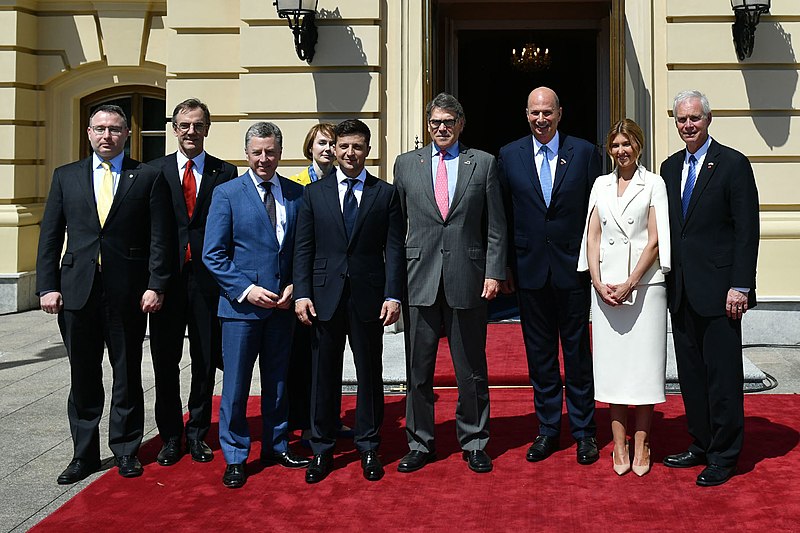
Delegation (left to right): Alexander Vindman, Joseph Pennington, Kurt Volker, Olena Serkal, Volodymyr Zelensky, Rick Perry, Gordon Sondland, Olena Selenska (First Lady), Ron Johnson at Zelensky’s Presidential Inauguration, 2019
Photo from Wikimedia Commons

The Trump administration has challenged American norms of civil-military relations. Candidate Trump signaled that he would reverse established law and attack commonly held norms when he promised to reauthorize waterboarding, and he further challenged tradition by appointing an unusual number of serving and retired generals to senior positions and referring to them as “my generals.” In this hyper-partisan environment, the military has struggled to maintain a non-partisan position. Maintaining it became unexpectedly harder last week when a serving military officer, LTC Alexander Vindman, was drawn into the impeachment inquiry, and the president subsequently attacked him personally.

Faced with this challenge, the military’s priority is to remain outside the partisan fray and maintain its position as a trusted national institution. Political actors, including the president, are attempting to use the military’s prestige to bolster their positions. This prestige, however, rests on the tradition of non-partisanship.

Decisions about when and how to go to war are inherently political because they have political consequences, but the military has traditionally provided advice on matters with political implications while scrupulously avoiding any participation, even indirectly, in the partisan contestation of elections. In a time when every question is contested on a partisan basis, every answer becomes partisan. The military must tread an extremely narrow path to fulfill its obligations without straying any further than necessary into partisan conflict.

Testifying truthfully before Congress should not be a partisan issue, but there is no way to avoid appearing partisan in modern politics. Refusing to testify is perceived as partisan by the one party; agreeing to testify is perceived as partisan by the other. Assertions that LTC Vindman could be court-martialed for testifying are far-fetched, but he has been vilified in the conservative media and will likely retire at his current grade despite his stellar credentials.

LTC Vindman’s situation presents a dilemma for military leaders attempting to sustain non-partisan norms. So far, senior military leaders have neither criticized nor defended Vindman. There are no grounds for criticizing him, but to defend him would place the military establishment in direct conflict with the president and create the appearance that the military is taking a side in the impeachment debate. For military leaders, the priority should remain protecting the military’s non-partisan legitimacy. This may, unfortunately, include tolerating unfair treatment of one of their own. Up to a point, the institutional legitimacy of the military is more important than the mistreatment of one individual.

Opponents of the president may be tempted to make Vindman into a heroic symbol of resistance. They would be wise to resist the temptation. Conservative adulation of Lt. Col. Oliver North after he testified to Congress regarding the Iran Contra Affair in 1987 reinforced the growing perception at the time that the military was closely aligned with the Republican Party, which subsequently undermined the military’s credibility and prestige. [1] 

The real test will come if the president and his supporters continue to attack Vindman publicly or attempt to take legal action against him. Retiring as a lieutenant colonel may be unfair, but it is a small price to pay for defending the norms of civil-military relations. If Vindman testifies in open hearings, the president and his supporters are likely to engage in public character assassination in order to undermine his testimony. The president has already shown his willingness to intervene directly in military legal proceedings.

Military leaders can be excused for accepting some costs to Vindman in exchange for protecting the military institution, but they cannot allow him to be prosecuted or maligned publicly by the president in a way that could make him a target. If the president pursues his standard playbook of innuendo and harassment, he will place military leaders in a lose-lose situation – either publicly contradict the president in a highly-charged partisan matter or publicly abandon an officer to be persecuted for his honorable service. The president should understand that unfounded public attacks risk reluctant repudiation by his senior military leaders, and those leaders should privately signal their willingness to do so before it becomes a public spectacle.

Senior uniformed and civilian military leaders must prioritize the military’s non-partisan integrity in a highly partisan environment, but they must realize that they risk the same dilemma as LTC Vindman. Whether he chose to testify or not, his actions were bound to be seen as partisan. Now, military leaders will face the same problem if the president forces them to choose between defending Vindman or abandoning him. The president and his supporters will view the former as partisan resistance, and Democrats will view the latter as partisan acquiescence. The president should avoid creating that dilemma, and military leaders should let him know now, before it again bursts into public view, that they too will speak truthfully and publicly if forced.

[1] Peter Feaver and Richard H. Kohn, Soldiers and Civilians: The Civil-Military Gap and American National Security (MIT Press, 2001).

Joe the Plumber and the Descent of the GOP

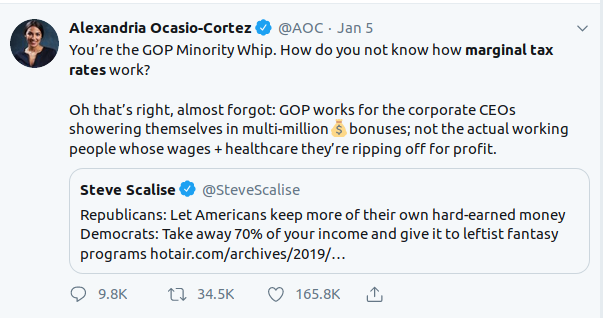
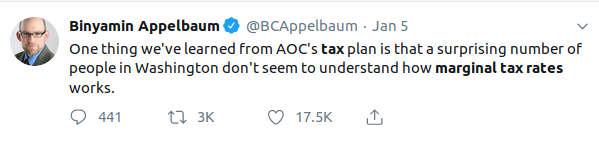
Last week freshman representative Alexandria Ocasio-Cortez set off a bit of a Twitter storm by suggesting a 70% marginal tax rate to fund her “Green New Deal.” Whether a 70% marginal tax rate would raise enough money to do so is a technical question and one I am not qualified to address in any meaningful way. Of more interest to me was the followup, in which various Republicans implied that her proposal would take 70% of some constituents’ incomes and Rep. Ocasio-Cortez shot back that they did not seem to understand progressive taxation or marginal tax rates. The exchanges jogged my memory in a way that illuminates the core problem of the modern Republican party.

In October, 2008, with John McCain only weeks away from badly losing the presidential race, Samuel Joseph Wurzelbacher confronted candidate Barrack Obama at a campaign event and challenged him about his plan to raise federal income taxes on people making over $250,000 per year. Wurzelbacher, who subsequently became known as Joe the Plumber, said he was about to buy a small business that he expected to “make” between $250,000 and $280,000 per year and Obama’s plan would make him poorer. Obama, professorial as always, delivered a brief explanation of marginal tax rates. It was not entirely clear whether Wurzelbacher meant that his business would have that amount of revenue or profit, although that level of profit for a small plumbing business would be surprising.

A poorly informed challenge to a candidate on the campaign trail is also not that surprising. The telling moment came three days later when Senator McCain made Wurzelbacher’s challenge the centerpiece of his final debate with Obama. Wurzelbacher almost certainly did not understand the difference between a flat tax rate and a marginal tax rate. His question implied flawed assumptions, and he would probably have been better off under Obama’s plan than under the then applicable tax law (https://www.nytimes.com/2008/10/17/us/politics/17joe.html). Although McCain was an expert in national security and the military rather than tax law, he certainly understood the difference. He had been in Congress for decades, and he was no dilettante, but sinking fast in his final presidential bid, he bet that his potential voters would NOT understand marginal tax rates and would react emotionally to the entirely fictional threat to raise their taxes.

McCain was famously one of the more principled members of the Senate during his tenure, and on a number of occasions he refused to participate in shameful pandering. The encounters in which he refused to humor supporters who called Senator Obama a Muslim and argued that he was therefore unfit or a security threat (http://time.com/4866404/john-mccain-barack-obama-arab-cancer/) may be the most admirable soundbites of any presidential campaign in my lifetime, but when it came to  tax policy, he was willing to demagogue and pander.

In 2008, tax cuts remained at the core of what it meant to be a Republican. McCain, to his credit, fought back against the populist xenophobia wing of his party. It certainly did not hurt that he himself suffered from it in the 2000 race when push polls in South Carolina attacked his adopted daughter (https://www.nytimes.com/2007/10/19/us/politics/19mccain.html). McCain saw that trend within American politics for the cancer it is, but he was a Reagan Republican to the core when it came to tax cuts. Tax cuts are also a technical issue, or at least they are within certain bounds. Lowering rates can stimulate economic activity and might, at some optimal level, raise tax revenues. Raising rates can retard economic activity and will most certainly prove disastrous at some level. The moral dimensions of taxation are much harder to identify. Finding the edges at which normal political maneuvering over a largely technical question begins to have serious consequences for large numbers of vulnerable people–and therefore becomes a moral question–is nearly impossible in real time. Lowering the top marginal rate from 39% to 37% is not an inherently moral question, but altering the tax structure of the country in a way that fuels massive inequality is. Whether that’s actually happened or not is a matter of debate (https://www.taxpolicycenter.org/publications/taxes-and-income-inequality/full) but to the extent it has not that is because Democrats reversed Republican tax cuts.

The point here is that GOP willingness to spout nonsense about tax cuts, assuming that their voters will misunderstand reality and reinforcing said misunderstanding, is not new and was even true of their most honorable recent candidate. Today, as tax cuts recede, at least rhetorically, from Republican centrality and are replaced by white Christian nationalism, the danger is that the habits learned from years of misleading tax debate bleed over into a topic that is ALWAYS a moral question. There is a zone of debate on immigration that is technocratic and reasonable, but we seem to have moved beyond that zone for the foreseeable future. The current GOP arguments on race and immigration pander almost entirely to a cohort of Republican base voters with hardened views. If the most honorable elements of the Republican Party apply to the issues of nationalism and xenophobia the same rhetorical methods they applied to taxes, then we are in for a very uncertain future.

Insanity = Expecting Different Results


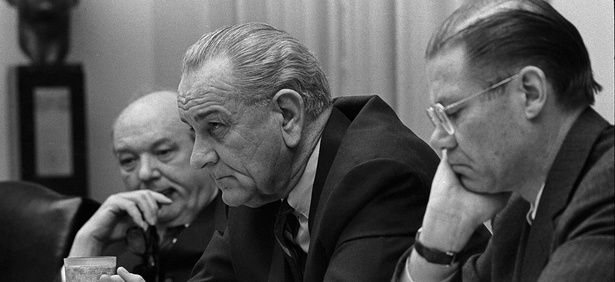
LBJ_McN“Bureaucracy Does Its Thing: Institutional Constraints on U.S.-GVN Performance in Vietnam.” by R.W. Komer. Rand Corporation, August, 1972. https://www.rand.org/content/dam/rand/pubs/reports/2005/R967.pdf

Readers who have served in Iraq or Afghanistan, but particularly Iraq, would be wise to lay in a stock of their favorite adult beverage before diving into Robert Komer’s first-hand study of institutional inertia in the Vietnam War. In his final chapter, Komer makes the accurate and vital point that the past does not provide a foolproof template for the future. That said, the past often provides a far better sense of what will not work that what will. Iraq veterans are likely to respond to Komer’s study with a fair degree of rage.

Known as “Blowtorch Bob” for his direct, unfiltered manner, Robert Komer served in Vietnam from 1967 to 1968 as head of the Civil Operations Revolutionary Development Support (CORDS) program. Having served on the National Security Council before Vietnam, including a stint as interim National Security Adviser to President Johnson, he was appointed Ambassador to Turkey in 1968. Though his in-country tenure was brief, it covered a critical period in the Vietnam War and followed years of direct involvement in Vietnam policy in Washington. Although CORDS was responsible for the “hearts and minds” campaign, Komer was no soft-hearted do-gooder. CORDS had both military and civilian staff, fell under Military Assistance Command – Vietnam, and was responsible for over 20,000 deaths through the Phoenix program of targeted assassinations.

In 1971, the Advanced Research Projects Agency, through the Rand Corporation, commissioned Komer to write a study of the ways institutional constraints and characteristics affected U.S. and Vietnamese prosecution of the Vietnam War. Komer’s overwhelmingly caustic and pessimistic assessment is even more remarkable for having been written three years before the final collapse of the South Vietnamese government. Nobody reading this study in 1972 should have been the least bit surprised when North Vietnamese tanks rolled into Saigon.

Komer made four observations that should give pause to anyone advocating for direct U.S. involvement in a civil war or insurgency in a distant country with an alien culture.

  1. “[T]o a greater extent than is often realized, we recognized the nature of the operational problems we confronted in Vietnam, and…our policy was designed to overcome them.” (v)
  2. Official U.S. policy directed a counterinsurgency response that never fully materialized on the ground; both U.S. and Vietnamese military leaders employed conventional military tactics regardless of policy guidance.
  3. “[The U.S.] did not use vigorously the leverage over the Vietnamese leaders that our contributions gave us. We became their prisoners rather than they ours; The [Government of Vietnam] used its weakness far more effectively as leverage on us than we used our strength to lever it.” (vi)
  4. The various agencies operating in Vietnam, regardless of the circumstances and guidance, performed their “institutional repertoires” with disastrous results.

Along the way Komer provides important insights into the questions of organization, civil v. military authority, and other tactical and procedural issues that played a role in the final outcome.

In the years since the end of the Vietnam War, a common picture has emerged of falsified or rose-colored reporting, inappropriate metrics (i.e. body counts), and relentless, unjustified optimism on the part of military leaders in Saigon. Komer strongly challenges that picture. While there are any number of examples of false or misleading reporting, and while the public benchmarks for success were unquestionably inappropriate, Komer makes a compelling forest/trees argument predicated largely on the record in The Pentagon Papers. Sure, battalion and brigade commanders may have inflated their body counts and pencil-whipped reports on “pacification,” but Komer argues that policy makers in Washington were well aware of the deteriorating situation in Vietnam, and that they recognized the causes of that situation. No matter how many fake trees may have been reported, the White House knew the forest was on fire.

Aside from accentuating the positive, official reporting tends to suffer from an obsession with quantification. Consequently, the government privileges indicators that can be quantified without regard to their relevance. In campaigns like Vietnam and Iraq, where there is no clear enemy order of battle, information that can be counted is often meaningless, and the most important information is often subjective, intuitive, and constantly shifting. When public support is the key to success, effective polling is the obvious measure of choice. Unfortunately, effective polling relies on a whole suite of conditions that do not exist in a war zone–accurate census data and security for pollsters first and foremost.

The situation is further aggravated when the metrics change constantly. Following the Vietnam War, the U.S. military reached the obvious conclusion that individual replacement every twelve months shattered unit cohesion, deprived the force of institutional knowledge, and created vulnerabilities. Unfortunately, DoD was unwilling, or politically unable, to come to grips with the implications of those observations. While the military eliminated individual rotations, it simply replaced them with unit rotations, thereby improving the unit cohesion problem at the expense of making the institutional knowledge problem even worse. At least under individual replacement, only about 1/12 of the force rotated in a given month. Under unit replacement, nearly all institutional knowledge would depart a given operational area within a week.

The rotation of units, combined with the careerist pressures of the military, caused each incoming unit in Iraq to select a largely new set of metrics to assess progress. Incoming units established new metrics, determined that their predecessors had left a mess, then spent 12 (or later 15) months working to improve the new metrics, at which point they rotated out and the cycle repeated. Ironically, this cycle of mismeaurement and misinformation did not require unethical or inaccurate reporting by anyone. Incoming units really did find a mess because the situation was generally deteriorating. They not unreasonably determined that their predecessors were both failing to improve the situation and measuring the wrong indicators. In setting new indicators, incoming units were careful to select factors that they could both affect and measure, knowing that failure to accomplish their goals would be career-ending for their commanders. Units were therefore able to improve their metrics while the situation around them worsened.

Komer’s articulation of similar dynamics in Vietnam over three decades earlier raises the obvious question, and accusation, why did we not learn? Why did we repeat the errors of our fathers?

This brings us to the central premise of Komer’s study and his most valuable insight. Large, bureaucratic organizations do what they are organized, resourced, and trained to do. They are generally very good at dealing with clearly defined, recurring problems. They are not good at adapting to new, poorly defined problems. Even when the characteristics of a new problem become clear and the solution is visible, existing organizations will not adapt unless shaken by a disaster and threatened with destruction–sometimes not even then.

To understand the military’s failure to adapt in Vietnam it is essential to bear in mind both its antecedents and its contemporaries. The generals who led in Vietnam mostly began their careers in World War II, a conflict of firepower, linear tactics, and large-unit engagements. They followed World War II with Korea, where effective conventional tactics eventually worked to achieve a stalemate that favored the U.S. and its South Korean allies. The highly superficial commonalities between Korea and Vietnam–wars against Asian Communists from northern rump states–caused U.S. military leaders to make a category error. Meanwhile, the war in Vietnam was never the main show for the U.S. military. Throughout the conflict, the U.S. military’s primary role remained deterrence of the Soviet Union, necessitating highly conventional force design, training, equipping, and doctrine.

This is the point that Komer drives home again and again. Bureaucracies “perform their institutional repertoires” and the institutional repertoire of the U.S. military, particularly the U.S. Army, was big unit wars against conventional enemies.

Komer’s study focuses primarily on the U.S. bureaucracy and the Vietnamese bureaucracy through the lens of its interaction with the American, and he clearly believes at a very basic level that better performance would have resulted in better outcomes. Nevertheless, he acknowledges the possibility that the problem was unsolvable and articulates the fundamental dilemma of great power counterinsurgency over and over.

The GVN’s performance was even more constrained by its built-in limitations than that of the U.S. In the last analysis, perhaps the most important single reason why the U.S. achieved so little for so long in Vietnam was that it could not sufficiently revamp, or adequately substitute for, a South Vietnamese leadership, administration, and armed forces inadequate to the task. The sheer incapacity of the regimes we backed, which largely frittered away the enormous resources we gave them, may well have been the greatest single constraint on our ability to achieve the aims we set ourselves at acceptable cost. (vi)

Quite simply, if the local government were not a complete mess, it would not need great power intervention in the first place. There is a disparity of motivation between the great power and the insurgent, but there is an equally large disparity between the great power and the supported government. A “victory” that requires the ruling class to surrender its power, wealth, or ideology is not a victory in their eyes, but civil wars and insurgencies rarely gain traction in societies with equitable distribution and representation.

Veterans of Iraq and Afghanistan will see clear shades of Baghdad and Kabul in Komer’s assessment of the GVN. Indeed, T.E. Lawrence’s 15th article points to his understanding of both the inherent problem and the difficulty, for effective soldiers, in overcoming it:

Do not try to do too much with your own hands. Better the Arabs do it tolerably than that you do it perfectly. It is their war, and you are to help them, not to win it for them. Actually, also, under the very odd conditions of Arabia, your practical work will not be as good as, perhaps, you think it is. (http://www.pbs.org/lawrenceofarabia/revolt/warfare4.html)

Lawrence was uncharacteristically humble in circumscribing his advice to the culture he knew well, but the same basic dynamic was at work in Indochina. The frustration of watching poor or corrupt performance is simply too much for the average western military professional, and yet poor and corrupt performance will be the standard in any nation requiring outside assistance. It is a paradox understood by experienced counterinsurgents (and parents of teenagers) that providing less assistance can engender better performance. Komer points out that President Johnson’s limitations on troops and bombing following the “Tet shock” forced “the GVN and ARVN at long last to take such measures as manpower mobilization and purging of poor commanders and officials. After Tet 1968, GVN performance improved significantly” (142). Komer’s observation of bureaucratic behavior and limitations combined with the paradoxical realities of counterinsurgency pose a cautionary tale for anyone contemplating intervention.

The U.S. military of 1965 (or 2001) was an enormous organization, run through almost comical levels of bureaucracy by necessity. There is simply no other known method of organizing and operating a worldwide organization requiring millions of people and billions of dollars. Contrary to the mythology of Hollywood and Washington, DC, bureaucracies are not made up of or run by mindless drones, imagining new forms to require so they can be left in peace to enjoy their donuts and cigarette breaks. Bureaucratic leaders tend to be thorough, energetic, optimistic, and ambitious, and they are generally highly reliant on rules and order. They advance by closely following established procedures and avoiding embarrassment. When intervening in a civil war or insurgency, we place such leaders in a chaotic situation in which they have little control over actions or outcomes and are surrounded by people whom they see as incompetent, corrupt, and deceitful. Because their careers depend upon providing measurable results and avoiding embarrassing failures, they have strong incentives to gain control of the immediate tactical situation and to emphasize areas in which they can control the variables. In other words, they are exactly the wrong people to operate in the roundabout, oblique manner that Lawrence recommended.

The problem is aggravated by the mismatch between rhetoric and reality. During the Vietnam War, the U.S. government claimed that maintaining a friendly South Vietnam was a vital U.S. national security interest, but it never acted in a way that supported that claim. In both the Civil War and World War II, the U.S. Army enacted tectonic shifts in its manner of operations, admittedly facing resistance at every turn, because the unprecedented threats provided the impetus to overcome bureaucratic inertia. The Army’s approach to Vietnam (and Iraq and Afghanistan) demonstrated that its leaders did not believe their own dire assessments of the war’s importance. The Army failed to alter assignment policies or organization in ways that would have materially improved its efforts, even when those changes were identified. Moreover, the Army’s inertia may have been a rational response to the situation. The U.S. faced the Soviet Union in a peer competition that threatened the destruction of human civilization, while the 1975 collapse of the South Vietnamese regime with almost no significant consequences for the United States proved that the threat there had been badly overblown. Organizing to fight a conventional, mechanized war against regular units was precisely what the United States should have been doing in the 1960s.

Recent work by Walter C. Ladwig, III (“Influencing Clients in Counterinsurgency: U.S. Involvement in El Salvador’s Civil War, 1979–92,” International Security, Volume 41, Number 1, Summer 2016, pp. 99-146) raises the possibility of alternative approaches that do not rely so heavily on the adaptability of rigid military bureaucracies and do not commit U.S. prestige so decisively. Inherent in the more indirect approach, however, is the willingness to fail. While “failure is not an option” is rarely actually spoken in the military, the phrase “we don’t plan for failure” is common. Planning for or accepting the possibility of failure is anathema to the successful military officer in the same way that standing by and watching local partners accept bribes or perform incompetently is. However, the willingness to fail is a basic necessity for U.S. intervention in wars of choice if we do not wish to keep repeating the mistakes of Indochina, Afghanistan, and Iraq.

Once we accept the premise that the outcomes in places like Vietnam and Iraq can be desirable without being essential, we can correct the category error that has led us to excessive, but ultimately failed, full-scale military intervention. A civil war in a strategically useful but not essential country on the far side of the world may be a war for the people who live there without being a war for the United States. That is not to say there will not be violence or U.S. casualties–both occur often without being deemed a war–but they will not require mobilization of the nation or national commitments of prestige to the point that the U.S. cannot accept failure. Rather than view them as wars, U.S. decision makers can view them as investments, and just as with an investment they can define what risk they are willing to take and build an alternative plan for failure.

Komer describes the failures of the various command structures throughout the Vietnam conflict. Despite the recognition that the conflict was primarily political, the military always ended up in charge because it provided the bulk of the resources. Ambassador Henry Cabot Lodge was allergic to managing, and Ambassador Maxwell Taylor, who seemed to be the perfect “civilian” to merge the various efforts and subordinate the military, instead deferred to the generals and the military command structure from which he had sprung. In his conclusion, Komer argues that ad hoc organizations may be superior to repurposing existing organizations because they will not be so wedded to “institutional repertoires.” He maintains that such ad hoc organizations were generally effective in Vietnam, but it is worth noting that the Coalition Provisional Authority that nominally ran the early campaign in Iraq was a conspicuous failure. Theory and common sense would tell us that a strong ambassador is the right person to head such an effort, but history gives us reason for caution. This dynamic might be more functional in an environment with less military presence–the overwhelming resource disparity lends power to the military chain of command that civilian agencies find hard to overcome. A more indirect approach might reduce that inequality by lowering the requirement for and value of military contributions.

Regardless of the command structure, it is essential to identify measures of both performance and effectiveness, determine the indicators and resource collection, and then follow the evidence to legitimate, no matter how unwelcome, conclusions. Komer devotes extensive space to assessing the assessments and reaches the conclusion that an external review is a necessity. In Vietnam the Office of the Secretary of Defense (OSD) conducted, in Komer’s view, excellent analysis, but the Joint Chiefs of Staff formally objected, twice, to OSD analyzing military performance in the field. In Vietnam, MACV consistently analyzed the wrong data because their theory of the war was wrong. In line with fighting a conventional war, they developed conventional order of battle metrics that failed to capture meaningful information. This is one lesson the U.S. military learned between 1975 and 2003 but did not follow to an effective solution. In Iraq, U.S. forces attempted to measure factors they associated with counterinsurgency, but DoD and the theater commanders never agreed on a standardized set of metrics, and they never resourced collection of the most relevant, and difficult to collect, data regarding public opinion. Consequently, incoming units frequently designed new metrics and started from new baselines, providing a hodgepodge of data covering 12, 15, and 9-month increments but useless for long-term comparisons.

While the ideal command arrangement is open to debate, the need for external, objective analysis is clear. In future, an honest broker, unbeholden to the chain of command, must collect and analyze relevant data across the entire duration of U.S. involvement in any conflict. Such an organization must be resourced to collect the necessary data regardless of cost or difficulty. Just as a venture capitalist would not commit funds to an enterprise without identifying indicators of success or without access to vital information, the U.S. cannot blindly commit itself without the ability to judge its own performance. Such an independent analytical organization, paired with an effective “red team” to challenge assumptions about the opposition might provide leaders with the necessary information to make hard decisions.

It is certainly true that history does not repeat itself–one of Komer’s key points is that each national situation is unique–but history does highlight institutional weaknesses that can operate similarly across multiple situations if not corrected. Bob Komer’s study of institutions in Vietnam is likely to strike a chord with anyone who has spent more than a week working in a bureaucracy, and it is likely to resonate painfully with those who watched the U.S. military flounder in Iraq and Afghanistan. It often leaves the impression that U.S. counterinsurgency theorists skimmed his chapter on possible viable alternatives without bothering to place it in the context of the entire report. Komer’s observations provide a devastating view of the inherent obstacles to great power intervention, and the history of such adventures since 1972 offers little reason to believe we can overcome them.

Conservatives are Coming to Terms with White Christian Nationalism

Democrats have had a tough year–a really tough year. Much of the struggle resulted from the decision to count on demographic change and the awfulness of Donald Trump to deliver the White House for Hillary Clinton with little regard for Clinton’s weakness as a candidate and the realities of polling. Democrats, if they wish to regain a governing role and move the country toward a more progressive future need to figure out a coherent platform that grows and stabilizes the middle class while protecting the progressive gains of postwar America.

Republicans, on the other hand have appeared to have a great year. They continue to control the majority of statehouses and governorships. They have the appearance of a decisive majority in House of Representatives and managed to retain a slim majority in the Senate despite an unfriendly election map. But Republicans don’t seem particularly joyful about their victory and with good reason. Taking back the White House under the banner of Donald J. Trump is at best bittersweet for Reagan’s acolytes. The House majority has so far proven itself unable to pass important legislation without caving to Democratic pressure–the House majority rests on three dozen or so recalcitrant “conservatives” who retain their seats by voting against every bill and trash-talking the House leadership. This morning’s New York Times Opinion section offers a cautionary note for the GOP in three articles by conservatives and religious commentators. R.R. Reno, editor of First Things, urges Republicans to embrace nationalist ideology as their touchstone to replace Reaganite small governance. Robert P. Jones, chief executive of the Public Religion Research Institute, details the collapse of a unifying American ideology into two opposed, and perhaps irreconcilable camps and Katelyn Beaty, editor at large for Christianity Today, takes conservative Christians to task for their reflexive defense of powerful men who harass and assault women, . Each is interesting in itself, but taken together they tell a story of current power without a clear path forward and with potentially dire implications for the country as a whole.

Reno quite correctly points out that middle and working class Americans have abandoned the Democratic party and the Reaganite core of the Republican party because they sense that they “no longer count,” and Reno lays that blame firmly on both parties. He does not, however, explicitly acknowledge the historical arc that he himself articulates. He begins with the observation that, “Over time, however, that iteration [Buckleyite small government] of Republican conservatism became less salient, in large part because it won.” Later he tells us, “The once vast and unifying middle class has eroded over the last generation. Today we are increasingly divided into winners and losers.” He fails to draw the straight line between those two statements. The “last generation” that saw its wages stagnate and its place in the middle class erode was the generation that grew up during the full fruition of Reaganite taxation and spending policies. A 35-year-old today who cannot find steady employment with a pension and health insurance was born in 1982. Even more telling, Donald Trump outperformed Mitt Romney in counties that skewed older–in other words with the voters who moved to the Republican party in droves in 1980 and 1984 but never saw prosperity trickle down as they were promised. Reno places the blame for that stagnation on globalization and blames both parties for embracing it, but he does not even acknowledge the correlation between the implementation of laissez-faire tax and labor policies and the collapse of the working middle class. For Reno, the answer is an overtly nationalist politics that rejects multiculturalism and globalization for policies that explicitly benefit Americans. The question he implicitly raises and fails to answer is what those policies might be. Republicans have told us for generations that unfettered free markets are the only economic system that builds generalized prosperity. Is he now rejecting that philosophy and asking us to trust its proponents to embrace its opposite?

The more pressing worry that Reno’s prescription raises is the uses to which such a governing philosophy is likely to be put. He offers no coherent economic theory to employ in his America First philosophy, and history tells us that populist economics, whether from the right or the left, rarely lead to generalized prosperity. When they fail, the alternatives are obvious and dire. Robert Jones tells the story of the parting of American philosophy–the abandonment of a nation built on a shared ideal in favor of one built on two irreconcilable world views. In one, associated with both the New Democrats and the Republican corporatists, ethnic and religious diversity, free trade, and commitment to a global commons are admirable goals, purely beneficial and even necessary for our continued functioning in an interconnected world. Opposed to this view are the white Christian conservatives who feel increasingly threatened as they move from majority to plurality to minority. White Christians are demographically threatened from both directions–minority races and ethnicities continue to grow as a percentage of the overall population while fewer and fewer Americans align themselves with organized religion. The combination of white Christian nationalist politics with the shrinking percentage of white Christians in the population raises an obvious danger. If the GOP forms a winning coalition of white Christian traditionalists today, how do they function in a few years when white Christian traditionalists are no longer a majority or even plurality? Do they willingly surrender their political power to opponents who espouse diametrically opposed values? History may not provide clear answers, but it furnishes plenty of warning signs. We see the future today in states like North Carolina and Texas, in which the non-white, non-Christian, non-traditionalists populations are growing. The reigning party responds with ever more extreme gerrymandering, voter suppression, and red meat legislation to hang onto power. Further, it is difficult to envision how a national politics that benefits white working-class voters can fail to benefit minorities and non-Christians unless the GOP completely guts the federal court system. Perhaps GOP nationalists will not demand that it do so, but that is unlikely. Perceived advantage is far more powerful than absolute prosperity. Republicans have historically been disappointed by Supreme Court justices, most recently John Roberts, who fail to be completely partisan once they reach the highest court. A court dominated by Republican appointees will certainly prove more conservative than it might otherwise have been, but it may not be willing to transform the United States into a white nationalist state. Pending cases regarding state support for religious institutions will provide an interesting test, but the court may not be willing to privilege Christian institutions as overtly as GOP constituents would like, and that could place states in the position of funneling public dollars to mosques and temples as well as churches, or reversing themselves completely on the blending of church and state.

Which brings us to Katelyn Beaty’s challenge to conservative religious communities’ tendency to rally around powerful men and forgive their sins while blaming their victims. Combined with the conservative embrace of overt nationalism and the declining demographic share of white Christians, the evangelical propensity for, “insular organizations that resist external checks and revolve around authoritative men” is exceedingly dangerous. When faced with scandalous behavior by their charismatic leaders, and Beaty catalogues a disturbing but merely representative sample, these organizations too often defend institutions and leaders rather than their professed values. They have shown an obscene willingness to blame powerless victims for their victimization, as when John Piper claimed that, “‘a lot of Christian women are oblivious to the fact that they have some measure of responsibility’ in managing men’s lust.” Organizations that are already predisposed to easily forgive the sins of powerful white men while blaming women cannot be expected to restrain the uglier tendencies of white Christian nationalism in the face of rising demographic challenges. Moreover, without a functional economic model that improves the lives of their core supporters, they will ultimately face a choice between admitting failure or distracting the disappointed. In advocating a turn to nationalism, R.R. Reno does not argue that its protectionist rhetoric will work economically, only that globalist economics have not worked for the middle and nationalism is popular. Beaty’s criticism of evangelical leaders–and indeed we have examples from other faith communities as well–point to an explosive destination for the current trend of conservative policies.

The short history of the Trump administration to date indicates a continuation of white nationalist rhetoric, sops to conservative Christian voters on hot-button issues, and economic policies that continue the consolidation of wealth and reinforce the power of large corporations and the financial industry. Advocates of nationalism like R.R. Reno had better look long and hard at what they’re advocating and consider how it ends. Their criticism of the real effects of globalization are accurate up to a point–the point where they have to accept the role of conservative tax policy–but that doesn’t make nationalism any more appealing or viable except in the immediate electoral sense. To those jumping on the white Christian nationalist train, beware you don’t burn down the country to win an election.


Donald Trump and Fourth Generation Politics

I wrote this in February but never published it. I was job hunting at the time, and one of my interviewers had a Donald Trump cookie jar on his desk. This didn’t seem like the sort of thing I needed on the web during a job search. Two months later I’m still job hunting, but I do not want to work anywhere that will expect me to stop analyzing the world as honestly as I can.


Before any discussion of the election, we should stipulate to one fact–it was a damn close thing. 79,646 votes in 3 states tipped the race. That’s 79,646 out of 128,824,246 or roughly .06% of the votes cast. It would be unwise, then, to draw too many sweeping conclusions or any conclusions that are too sweeping from these results. No one event put Donald J. Trump in the White House. Had the FBI not interjected on two occasions, had Hillary Clinton built an impregnable firewall between the Clinton Global Initiative and the State Department, had the Russian security services not hacked the DNC and campaign e-mails, we might be listening now to Donald Trump’s fevered rantings about a rigged election (oh, wait….).

The more interesting question, however, is what would have happened without Trump’s perceived own goals? What if he had NOT been caught on tape in that bus with Billy Bush? What if he had NOT attacked Khizr and Ghazala Khan? What if he had NOT attacked a federal judge for his ethnic heritage? There is no question that some of Trump’s perceived liabilities were real liabilities–his many bankruptcies and the Trump University lawsuits undermined his core narrative of business genius and straight talk. The victims of Trump University were exactly the sort of voters Trump needed to win. His outrageous statements and tweets, however, may have been an asset. Plenty of people have looked at how they were received in Trump country, generally focusing on the remarkable extent to which his supporters failed to care. What we haven’t really studied is how they affected the Clinton campaign. Did they draw the Clinton campaign into some of the classic failings of counter-insurgents?

As Donald Trump moved from one outrage to the next in the summer of 2016, it is understandable that Hillary Clinton’s highly conventional campaign targeted his offensive statements and turned their resources to ensuring that as many people as possible were aware of and outraged by Trump’s statements about women, Latinos, Muslims, African-Americans, and others. Barack Obama had won two consecutive presidential elections by building a coalition of various identity groups and by running a remarkably competent and efficient campaign that mastered the blocking and tackling of 21st century politics. Many observers, myself included, believed that Hillary Clinton would win the election by energizing the various elements of the Obama coalition and then doing the basic manual labor of voter turnout in the key swing states during the voting weeks. Trump showed no signs of understanding, let alone mastering, the mechanics of modern elections. While turning his ground game over to the Republican National Committee might have been smart outsourcing in some elections, it placed the party in an awkward position in key swing states with candidates for the Senate and House distancing themselves from the presidential candidate. How could the party turn out the swing voters it needed to retain the Senate without those same swing voters undermining Trump? In the end, of course, it didn’t matter. 79,646 voters in three states turned the tide, and GOP Senate candidates in all three states retained their seats, even Wisconsin’s Ron Johnson, judged the most endangered candidate of the election.

Those of us who have spent the past decades fighting Islamic insurgencies in Iraq and Afghanistan can apply some of what we’ve learned to understand one of the reasons Hillary Clinton failed. As Donald Trump offered up softballs in the form of open mic recordings, 4 am tweets, and disastrous debates, the Clinton campaign began focusing their efforts on highlighting Trump’s own words. In the first debate, Clinton laid an obvious trap for Trump by awkwardly bringing up Alicia Machado out of seeming thin air. Trump appeared to walk straight into the trap–signaled by the obvious non-sequitur–and Clinton’s campaign promptly dumped their carefully prepared opposition research on the airwaves. From the beginning of the Democratic convention to election day, Clinton banked on the power of identity politics and uniting various groups in a sufficiently large coalition to overcome the shrinking pool of white, male voters.

Mao famously stated that the revolutionary is a fish who swims in the sea of the people. Insurgents blend into the population because it faces counter-insurgents with a painful choice between two evils. If the counter-insurgent strikes the insurgent within the population, he causes collateral damage, killing innocents, destroying homes, and increasing sympathy with the insurgent. He creates opportunities for the insurgent to show his concern for and connection with the people. In Lebanon, Hezbollah differentiates itself from the government with extensive, efficient, prompt, and legitimate social services. The Muslim Brotherhood and its various offshoots and imitators have always maintained a symbiotic relationship between their social services and their political/military arms. In Baghdad, the Office of the Martyr Sadr provided food aid to those who attended Friday sermons, sermons favorable to the Jaish al Mahdi militia and the Sadrist movement.

If the counterinsurgent chooses not to strike, then he faces a different set of problems. He cedes the people to the insurgent who lives openly in defiance of authority. The government looks weak while the insurgent looks fearless and strong. If the insurgent holds a rally in public without response from the government, then his authority challenges the government’s. If the insurgent dispenses justice through “revolutionary courts,” the swift decisions paint a glaring contrast with the tedious and often corrupt proceedings of the official courts. Because the insurgent is not bound by the rule of law, he can play both sides by impeding official courts, through intimidation of witnesses for instance, and then dispensing swift and effective justice from his own courts.

By attacking women, Muslims, Latinos, the disabled, and others, Donald Trump may have been employing the insurgent handbook, albeit without having ever read it. When faced with the Hobson’s choices above, too often counter-insurgents choose to hit the targets they can hit, simply to show that they’re doing something. In Iraq, Sadr City housed over 2 million people, but it was effectively inaccessible to both Iraqi government and foreign forces. Coalition targeting was guided first and foremost by accessibility. There was no sense worrying about targets we could not reach. Every once in a while that played to our advantage when senior leaders’ tolerance for risk increased and changed the ground rules. In the spring of 2008 with Sadrist forces firing rockets into the Green Zone and the airport, the powers-that-be accepted the risks of a series of strikes judged too costly before. Over three days in May we struck three times, the last with six MLRS rockets as close as 30m from a hospital, and the Jaish al Mahdi leaders fled Baghdad. For a brief moment, we gained an advantage, but then we failed to press it home.

Hillary Clinton’s campaign was prepared to fight a policy election. She posted hundreds of carefully crafted and vetted proposals that addressed real issues. Because she had decades of policy experience and a competent, experienced staff, the proposals were coherent and feasible. She went out of her way to ensure they were all paid for through some means or other so Republicans could not attack her for wild deficit spending. Her policy portfolio had the strength of realism but lacked the strength of simplicity. Because these were real policies to deal with complex, difficult problems, there was no way to reduce them to sound bites.

Donald Trump frustrated the Clinton campaign by failing to produce any policies. He literally disbanded his embryonic and understaffed policy shop. Not one of its products ever made it to Trump’s mouth or the campaign website. To the governing professionals of the Clinton campaign and the college-educated voters of the cities, Trump’s policy desert seemed like a glaring weakness, but it presented a challenge. Every time Clinton proposed a carefully constructed policy, Trump responded with an unsubstantiated claim that his policy would be better. Clinton could not attack Trump’s “tremendous, beautiful” policies, because they didn’t exist. She couldn’t compare the costs of his policies because they were too vague to score. The Mexican border wall presents the clearest example. Building a wall between Mexico and the U.S. is a laughable excuse for an immigration policy. Clinton was quite right to point out that it did not address the way illegal immigrants come to the U.S. today, that border walls have been frequently defeated in other countries, and that the wall would be difficult, if not impossible, to build and very expensive. Trump responded that he was a builder (as if that somehow overcame the laws of physics), that his wall would be bigger than other border walls (as if the others had failed because they were too short), and that Mexico would pay for the wall. He never settled on just how high his wall would be, so it was impossible to demonstrate that the height would not make a difference. He never addressed the issues of terrain or land ownership that will impede the wall. And most notably, he never explained how he would get the Mexicans to pay for a wall they oppose.

Clinton’s campaign, faced with a shifting set of simplistic, squishy soundbites in place of a policy portfolio decided instead to attack the available target–Trump’s character. Unable to fight on the ground of their choosing, they launched missiles at the targets that presented themselves. Here is where the counterinsurgency analogy is useful. It is quite possible that those 79,646 voters did not see Trump attacking a Gold Star family. They saw him attacking a Muslim man with brown skin and an accent. They were disturbed and uneasy about the encroachment of multi-culturalism into their formerly lily-white lives, and Clinton’s attacks on Trump seemed to be attacks on them for feeling uneasy. If you don’t want to press 2 for English and you want to be surrounded by people who share your values, your language, and your heritage, then you are racist, she seemed to say. Those of us who live in multicultural urban areas understood her perfectly, but Trump voters were the sympathetic civilians blown up by the airstrike. She was attacking their view of themselves, and that just made them more defensive.

Insurgencies succeed because of cultural affinity. Successful insurgents manage to convince a sufficient number of people that the insurgents share their values and concerns while the ruling elites are aliens. Ethnicity and religion form the most effective cultural glues, but sometimes economics or other markers can suffice. The Clinton camp made the mistake of believing that Donald Trump, billionaire, could never forge a strong enough bond with white working class voters to get him over the top. They failed to understand that Donald Trump, Kentucky Fried Chicken eater and inarticulate spouter of jingoistic platitudes, felt far less alien to those voters than college-educated urbanites steeped in the language of multicultural cosmopolitanism. By striking the targets of opportunity–Trump’s offensive speech–Clinton failed to do the hard work of forcing Trump to fight on policy grounds. Rather than force him to defend his misogyny (the very word screams “liberal elite”) she might have forced him to articulate a plan for health care, or at least made him pay for his lack of a plan.

So when and how do insurgencies fail? Some fail because the government manages to align with the people. It addresses their legitimate grievances while drawing the insurgents into undeniable atrocities. People begin to blame the insurgents for their miseries and for blocking the government from improving their lives. Often, the very identity factors that aid some insurgencies play against others. For instance, the British counterinsurgency in Malaya provides a rare example of a foreign power defeating a large-scale insurgency, but the Malayan insurgents were nearly all ethnic Chinese. They were just as alien to the bulk of the Malayan people as the British, and in this case the impermanence that often defeats external counter-insurgents played to the British advantage. By the time of the Malayan emergency, the British Empire had crumbled, and a British victory was almost certain to lead to independence. A rebel victory, on the other hand, seemed likely to lead to permanent rule by Communist ethnic Chinese.

Unfortunately, insurgencies most often fail after they succeed. The prime tools of the insurgent are chaos and disruption–anathema to actual governance. Successful revolutions nearly always result in purges because the best revolutionaries are incapable of governance. Sometimes, as in Algeria, the purge happens before the revolution is won as ruthless leaders send the true revolutionaries out to die in the final battles, leaving the field clear for post-war reconstruction. In the Soviet Union, the ruthless dictatorship of Lenin gave way to the Stalinist terrors, and Mao followed up his successful revolution with decades of murder and chaos.

The Trump campaign seems, however, to bear more resemblance to the Arab revolt. The first two weeks of the Trump presidency look more and more like the scene in Lawrence of Arabia after the Arabs take Damascus. That leaves people concerned with governance another Hobson’s choice: hope for Trump to get his act together so he doesn’t drag the country down into chaotic dysfunction, or hope Trump fails utterly so he doesn’t drag the country down into an authoritarian dystopia. Which you choose depends on just how dangerous you thing Trump really is.

Starting Over

I’ve blogged intermittently for a few years now. As a serving military officer, I was constrained in what I wrote for publication, even on a blog that nobody was reading. In the past year or so I’ve used the platform primarily as a repository for book reviews, and I’ve use the book reviews primarily to remember what I’ve read and what I thought about it. Middle age does terrible things to the memory.

Now that I’m retired, I feel the urge to speak more freely. This blog will serve at a minimum as a vent for the thoughts clogging up my head–as a way to sort through mental impulses and first impressions and turn them into coherent ideas with proper sourcing. I will need to discipline myself to think ideas through and critique them before they come out.

It will also serve to put first drafts out where others can see and critique them. Consequently, it’s important to note that this blog may contradict itself from time to time, or even frequently. It may include half-assed thoughts that seemed clear and well-supported when I typed them. If I subsequently think better of them, or if readers (aw optimism) convince me I’m mistaken, I will endeavor to publish corrections in the same venue in which I published the original error.


McDonald v. Chicago

For most of my life I’ve listened to the rant of conservative politicians and pundits against “activist judges” and “legislating from the bench.” Today, the Roberts court found in McDonald v. Chicago that the 14th Amendment incorporates the 2nd Amendment–a position clearly at odds with standard Constitutional interpretation from the passage of the 14th Amendment in 1868 until Gideon v. Wainwright in 1963. Ironically, Gideon established the right of publicly-funded counsel in criminal cases, a position loathed by judicial conservatives and frequently attacked since then. In the McDonald ruling, Justice Alito lays out the entire history of incorporation under the due process clause, as if to highlight the court’s steady departure from traditional interpretation and original intent–AKA legislation from the bench.

Since the outcome of the case is pleasing to conservatives, would anyone like to start a pool on how many Fox News commentators are outraged by this rampant case of judicial activism? My money’s on zero.