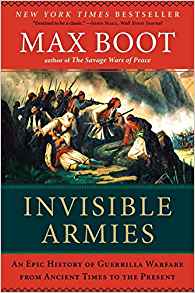
Review – Invisible Armies: An Epic History of Guerilla Warfare from Ancient Times to the Present

BootInvisible Armies: An Epic History of Guerilla Warfare from Ancient Times to the Present By Max Boot
Hardcover, 750 pages. Published 2013 by W.W. Norton & Co. ISBN: 978-0-87140-424-4

Max Boot attempts in Invisible Armies to construct a comprehensive catalogue of insurgency, terrorism, and revolution from antiquity to the 21st century. While his sketches are generally thin, and colored with his own neoconservative brush, the book provides a valuable encyclopedia for placing insurgencies in context. Boot’s categories are also useful as they reach beyond the normal list and challenge conventional assessments. For instance, Boot categorizes the first Ku Klux Klan as an insurgent and terrorist organization and makes a pretty strong case. Most American readers might prefer to leave the Klan off a list of insurgencies, particularly since Boot concludes they were largely successful in achieving their aims.

In conjunction with the book, Boot maintains the Invisible Armies Insurgency Tracker at the Council on Foreign Relations website (http://www.cfr.org/wars-and-warfare/invisible-armies-insurgency-tracker/p29917). The tracker, like the book, is a useful jumping off point for structuring research on insurgencies; however, the inability to download data in table form makes it more useful as a visual aid than as a tool for expanding and deepening research.

Review – The Strategist: Brent Scowcroft and the Call of National Security

ScowcroftThe Strategist: Brent Scowcroft and the Call of National Security By Bartholomew Sparrow

Hardcover, 717 pages. Published 2015 by PublicAffairs. ISBN: 1586489631
 
In the summer of 2013, I was standing in the Mansfield Room of the U.S. Senate during Senator Jack Reed’s annual reception for visiting West Point Cadets. As a chronic introvert, I have never figured out what to do with myself in rooms full of strangers, and I probably looked very uncomfortable. A slight, elderly man walked up to me, stuck out his hand, and said, “hi, I’m Brent Scowcroft.” Of course, I knew exactly who he was the moment I saw him, but his introduction seemed completely genuine–he really had no expectation that anyone would recognize him on the street. In a city of gigantic egos and talented, powerful people desperate to be recognized and revered, Brent Scowcroft stood out as someone who just wanted to do the work. 
 
Sparrow’s biography is masterful and thorough, but it’s also a doorstop. If you want a reference for just about every significant foreign policy challenge of the Nixon, Ford, and Bush 41 administrations, this is your book. It is particularly valuable for its review of the long, drawn out fall of the Soviet Union and the U.S. government’s responses. It is insightful on the internal deliberations, particularly of the Bush 41 administration, and illuminates some of the mysteries that have deviled outside observers. It turns out Dick Cheney was always like that.
 
It is virtually impossible to write a biography of Scowcroft that is not admiring. He is disarmingly frank about his own failures. One of the most telling passages is Scowcroft’s own admission that, “My notion about the world that I was entering intellectually as I got deeper and deeper into foreign policy did not really include a world without a U.S.-Soviet confrontation.” Bush’s wise decision to provide support to Gorbachev and the Soviet moderates and to resist the urging of hardliners to humiliate and dominate the Soviets probably provided the softest landing possible in a dangerous situation.
 
Sparrow’s narrative of the Soviet collapse also demonstrates the difficulty of making policy in a complex world. Bush and Scowcroft were steeped in the language, history, and dynamics of national security, and they made excellent decisions in purely national security matters. Neither was experienced in economic policy, and both, particularly Bush, were trapped in Republican economic orthodoxy. Consequently, economic support to the Soviet Union appeared to be an area where they could throw a bone to the hardliners while remaining within their overall paradigm. The resulting debt deals crippled the Soviets’/Russians’ ability to deal with their burgeoning economic crisis and laid the ground for future Russian political developments. 
 
The 1990-91 Persian Gulf War also demonstrated the limits of Scowcroft’s and Bush’s experience–nobody can be good at everything. While the Bush team took a nuanced approach to the Soviets, informed by decades of interaction and close observation, they took a more two-dimensional approach to Iraq and the Middle East. By demonizing Saddam Hussein so publicly, the team foreclosed their options for a negotiated settlement. They turned what was fundamentally a limited war for limited aims into a total war for regime change in the eyes of the nation. Their miscalculations stemmed not so much from any innate wish to mire the U.S. in Gulf politics as in their lack of understanding. Bush and Scowcroft did not see the possible futures in the Gulf as clearly as they did in Russia because they did not have the background and experience that so brilliantly informed their European, Russian, and China policies. As a side note, they were also taking flak from Dick Cheney throughout the crisis, and their more hawkish stance may have been influenced by the internal divisions. Having lost every battle on the policy toward Soviet devolution, Cheney pushed hard for a more hawkish stance in the Gulf–presaging his position 12 years later. Cheney’s (failed) insistence on letting Israel join the anti-Iraq coalition and his belief that Israel should have been encouraged to directly retaliate for SCUD attacks go far toward explaining his later disastrous judgements regarding Middle East politics and conflict. Cheney was always a terrible strategist, but the second Bush administration removed the failsafes.
 
Sparrow’s book also pays due attention to Scowcroft’s genius for and attention to process and organization. Here the lessons are somewhat contradictory. Scowcroft inherited a largely dysfunctional National Security Council process from Henry Kissinger during his first stint as national security adviser–a process further damaged by Kissinger’s presence as secretary of state and his dominant position within the administration. Within the constraints of the personalities, he managed to improve the process and serve as an honest broker for President Ford. In his second tour under G.H.W. Bush, Scowcroft ran an exemplary process that ensured input from all relevant parties and provided thorough, honest, and fully formed information and options to the president. Paradoxically, Scowcroft often achieved this excellent process through the creation of ad hoc working groups outside the official structures of the NSC. The effectiveness and dangers of such groups could be the subject of its own study. Under Scowcroft, they worked extremely well, but such groups proved exceedingly dangerous under the G.W. Bush administration when powerful actors used them to exclude dissenting voices and limit the options and recommendations for a president who lacked the experience and temperament to smell the manipulation. On the one hand, Scowcroft built an exemplary process and a smoothly functioning staff; on the other the process was completely dependent upon Scowcroft’s personal leadership. The ultimate lesson may be that process and organization matter, but they are ultimately tools of the individuals who execute and populate them.
 
The ultimate fragility of his process and organization also point to another partial failure–Scowcroft’s promotion of subordinates. While he championed and elevated superstars like Robert Gates, he was also an early mentor to Robert MacFarlane–a far more problematic figure. Most damagingly, Scowcroft lifted Condoleezza Rice early and quickly, only to see her manage–or fail to manage–a disastrous NSC staffing process in the wake of 9/11 and the runup to the Iraq war. Scowcroft recognized Rice’s obvious intelligence and talent without realizing that she was too young and insecure to do battle with Dick Cheney and Donald Rumsfeld. Where Scowcroft played the honest broker in the G.H.W. Bush administration, ensuring the president received the best advice and had a sober, experienced sounding board for ideas, Rice provided G.W. Bush with an enabler, lashing out at her former mentor when he dared question the conventional wisdom. Insecure in her position among the monstrous egos and misplaced certainty of the Cheney clique, she was unable to moderate their influence, and instead enlisted in their crusade. Her later tenure at State partially justifies Scowcroft’s trust and belief in her, but she was, ironically, out of her depth as the national security adviser, and Brent Scowcroft had put her there.
 
Committing to 700 pages on the life and work of a Washington bureaucrat is a serious investment. Bartholomew Sparrow has has made it worthwhile for any reader interested in the unglamorous process of formulating and implementing national security policy, but do not take this book to the beach for a light read. In Scowcroft, Sparrow has found the exemplar of what policy-making should look like, illustrating both the process at its best and the limits of the process even when executed by a quiet master with the full support of the president. It should be both a primer and a warning.
Review – WAR

JungerWAR by Sebastian Junger.
Kindle Edition, 297 pages Published May 11th 2010 by Twelve (first published 2010) ASIN B0035II95C

Sebastian Junger’s WAR is the best encapsulation of America’s wars at the dawn of the 21st century from the soldier’s point of view. Period. I never experienced the sort of intense, sustained, infantry combat that Battle Company fought in the Korengal, but I saw enough to hear the ring of truth. Junger did what so few are willing to do–he patrolled, ate, slept, crapped, and smoked with infantry privates and sergeants, on the ground, in the worst place on earth for a year. Long enough that they trusted him. Long enough that he learned their language. Long enough that he began to understand their stir craziness, fear, love, anger, and apparent derangement that was really sanity.

Junger’s prose is perfect for the story he’s telling–simple and unadorned. Sentences like these boil the infantry war down to its essence: “Wars are fought with very heavy machinery that works best on top of the biggest hill in the area and used against men who are lower down. That, in a nutshell, is military tactics, and it means that an enormous amount of war-fighting simply consists of carrying heavy loads uphill.”
 
In portraying the attitudes of Battle Company’s soldiers, Junger captures the combined political ambivalence and personal camaraderie that so confuses and angers observers back home. War supporters want veterans committed to the abstract goals of war and willing to sing the neoconservative siren song. War opponents want victims, duped into a stupid war and used up as cannon fodder. Neither is satisfied. Junger captures the reflexive support for fighting common among frontline soldiers. How can you continue to fight for a lie when you’ve seen your brother ripped to pieces by an RPG? At the same time, soldiers on the ground have little patience for the political posturing of the world’s Dick Cheneys. They know exactly how badly things are going on the ground. They know that “turning the corner” generally means walking into a well-laid ambush. They know that support for the government is not rising among remote villagers who may not even know there IS a government. Junger refers to Vietnam moments: “A Vietnam moment was one in which you weren’t so much getting misled as getting asked to participate in a kind of collective wishful thinking.” Explaining why men continue to fight when they have no deep commitment to the cause, Junger writes, “collective defense can be so compelling — so addictive, in fact — that eventually it becomes the rationale for why the group exists in the first place.”
 
That, in the end, is the horror of war. It takes people from a wealthy, comfortable, civilized country and debases them to tribal warriors living in squalor so they can dominate and control tribal warriors who were born into squalor. Just as the Afghan mujahideen have adapted ancient methods of warfare to incorporate RPGs and rockets and cell phones, American soldiers with all their technological marvels still become primitive beings, driven by deeply rooted instincts that evolved to protect itinerant hunter gatherers. Technology does not civilize war–if the fight is serious enough, even enough to threaten both sides, then it will inevitably devolve into a kicking, biting, scratching melee in which no one is any more civilized or merciful than any other. 
 
Junger does not so much capture new insights about war as brilliantly tell them in the context of the Afghan war. We have known throughout history that soldiers fought for their brothers beside them, that fear of showing weakness or letting down the tribe drives courage more than ideological commitment. We have known for millennia that small bands of determined guerillas can stop an army in its tracks. Junger captures the most recent version of these eternal truths in a tightly packed love letter that should be consumed by every aspiring second lieutenant and every gung-ho politician itching to send someone else’s sons and daughters to a fight. This is what you’re signing up for. There is nobility in the fighting, and sometimes it has to be done, but do not embark on it with a light heart. Do not believe that the men and women who do the hard, dirty work in distant valleys will come home unscathed. Do not convince yourself that every death will be noble and every sacrifice justified by the outcome. Junger does as good a job of telling the soldier’s story as any other author.
 
Read this book.

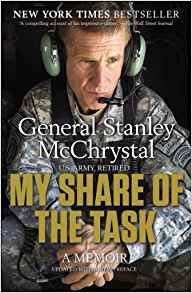
Review – My Share of the Task: A Memoir by Stanley McChrystal

McChrystalMy Share of the Task: A Memoir by Stanley McChrystal
Kindle Edition, 464 pages. Published January 7th 2013 by Portfolio. ASIN B007ZHCEN2

When Stanley McChrystal commanded the special operations task force in Iraq, he sent liaison officers to all of the major conventional commands, young majors and lieutenant colonels whom he hand-picked for their intelligence, their confidence, and their understanding of and links within his task force.  Some of them were steely-eyed operators from Task Force Green, and others were chemical corps officers or signaleers from his staff.  The common denominator was his level of trust in them, and he empowered them with unlimited direct access. In 2008, his liaison officer to my organization was a disheveled, slightly roly-poly naval officer, and my general–deeply committed to hierarchy and physical appearances–viewed and treated him as an insignificant minion.  Each night we would brief my general face-to-face on the fight against both al Qaeda in Iraq and the various Shia militias, and my general would heap scorn and abuse on “Gilligan,” the derisive local nickname for the liaison officer.  “Gilligan” would take it all quietly and professionally, and then retreat to his little plywood cubby, like Harry Potter under the stairs, and call directly to then Lieutenant General McChrystal at his desk and have a 20-30 minute conversation about our share of the task. McChrystal really did flatten his organization, and he had a remarkable facility for choosing and trusting competent subordinates as individuals rather than assessing everyone against the same cookie-cutter model.

Stanley McChrystal wouldn’t know me from a random panhandler, but I know him well.  Or rather, I have a clear perspective from the view of a junior staffer who watched him work and spent 20-hour days for nearly two years working with his organization.  His views on leadership, counterterrorism, and our national security establishment carry great weight for those of us who watched him and his outfit in action. Watching him lead a video teleconference at 2:00 in the morning bringing together multiple military and civilian organizations to achieve a common purpose was both a pleasure and an education.  McChrystal’s subordinates were fiercely loyal to this notoriously challenging task-master. He demanded much and only retained those who consistently delivered.  They would, and did, follow him into hell knowing he would resource their mission, back their honest mistakes, and never, ever, squander their lives.

It is, therefore disappointing that the majority of his memoir is so banal.  I began the book in a state of near hero-worship for perhaps the finest senior leader I saw in action in Iraq and Afghanistan, and I interpreted his comments in the introduction as a preview of thoughtful evaluation and tough talk to come. Instead, My Share of the Task is a workmanlike recounting of a story that has already been told.  McChrystal is far too gentlemanly to name names or air dirty laundry. The very characteristics that make him an extraordinary leader preclude him from dishing the dirt. Having ended his career precipitously due to excessive candor with a journalist, he is not likely now to be more open, and he is not the sort of man to bear grudges or settle scores.

That left him with two choices, and he chose the road more traveled.  McChrystal could have used his reputation and his personal experience at the very heart of the Global War on Terror to build a strong analytical case for what we should have done, what we did, and what we should do going forward. Instead he tells the story of the fight against al Qaeda in Iraq at the very tactical level. Creating an overall strategy was not McChrystal’s share of the task, and he should not be held accountable for failing to do it, but his title indicates that his book will stay firmly “in his lane” and therefore fail to provide much new or enlightening material. He then falls into the trap of personalizing the fight against AQI as a fight against Abu Musab al Zarqawi, a view belied by the recent rise of the Islamic State under Zarqawi’s successors.  Zarqawi’s death and the slaughter of mid-level AQI leaders in 2007 and 2008 dampened the violence and opened a geographic and temporal space for reconciliation, but the rise of al Baghdadi and IS shows that the grievances and viciousness of the Iraqi Sunni extremists was far larger and more entrenched than any single leader. The AQI emirs of 2008 were low-grade street thugs, a few murderously clever, but mostly just violent sociopaths with no particular charisma or organizational acumen.  The fuel for their insurgency, however, remained. If anything, the Maliki government stoked the fire.

McChrystal’s focus on AQI also demonstrates the strategic blindness of the entire U.S. Iraq operation. By 2007, Shia militias and Iranian influence posed at least as great a long-term threat to U.S. interests in the region as Salafist extremism.  Yes, AQI and Zarqawi were stoking the fires of sectarian hatred, but that fire was dangerous to the U.S. specifically because it opened the path for Iranian influence. Zarqawi’s fatal miscalculation stemmed from his combination of psychotic violence with poor math skills.  There was no way the Sunnis in Iraq could prevail once the Iranian-backed Shia militias were armed and supported by the Republican Guards Quds Force.  There were too many Shias with too many weapons, and they were willing to fight.  Toppling and suppressing them posed a much greater challenge than keeping them fragmented and suppressed had under Saddam.  Although one element of McChrystal’s task force focused exclusively on Shia militias, and even though those militias posed the greatest threat to U.S. forces by the end of 2007, McChrystal pays them insufficient attention.  He fails to step back and look not at whether his task force did a good job of fighting AQI (they did) but rather at whether the U.S. was focusing its efforts in the right direction.

McChrystal gets closer to a valuable analysis when he describes his early days as COMISAF/ COMUSFOR-A in Afghanistan, but then he slips into the can-doism that makes it so difficult for senior military commanders to provide useful advice to our civilian masters.  McChrystal holds Hamid Karzai in far higher regard than any other American official. He illustrates the mission creep that made any reasonable vision of “success” or “victory” in Afghanistan impossible, but he never steps back and seriously challenges the premises of the mission. Those who continue to push the Afghanistan mission beyond its narrow counter-al Qaeda foundation do not address how we, as outsiders, can build a functional Afghan state without sufficient buy-in from the various Afghan power-brokers, nor how we can generate that buy-in. Army officers do not reach four stars by telling their superiors “we can’t,” and McChrystal, despite excelling his peers in so many other ways, is no exception.  His assessment and the assessments of every other general to manage our longest war have hinged on a prescription for resources and time that take little account of political realities, even if the assessments are accurate in themselves.

I enjoyed reading My Share of the Task for the recap of events that shaped much of my past decade and a half. I knew some of the people who played roles in his operations, I’ve walked the ground he describes, and I was a back-seater in some of the meetings he recounts. It was a pleasant walk down memory lane, but it ultimately disappointed.

Gen Z and the National Security State

I just came upon this in Foreign Policy:

http://www.foreignpolicy.com/articles/2013/08/28/spy_kids_nsa_surveillance_next_generation (may be paywalled)

Well worth the time to read it.  I think Mr. Stross may be too pessimistic in the second half, but his basic insight is important.

1.  Things weren’t always the way they are now, and they won’t be that way forever.  Although Stross does not specifically address it, the atomized, international, deracinated world he describes bears a lot of similarities with many pre-industrial societies.  The nation state and its attendant norms, values, and security apparatus are all relatively recent developments.  Two hundred years ago, independent security contractors roamed Europe selling their services to the highest bidder.  We have a particular problem in the U.S. because we don’t even know our own history, let alone

2.  If your values and beliefs are too deeply ingrained, you mistake them as Truth rather than the culturally constructed opinions that they are.  This has helped polarize our politics, and it also makes us vulnerable to threats who just don’t see the world through the same lens (see suicide bombers, et. al.).  In 2007, a staff section in my division did a very simple generational analysis where they looked at recent Iraq history through the eyes of the largest and most dangerous cohort–mails between 15 and 35.  In three pages, they managed to completely demolish all of the easy assumptions upon which a bunch of 60ish, wealthy, Christian and Jewish, Americans had based their war plans.

3.  Just because something worked yesterday doesn’t mean it will work tomorrow.  Particularly in hierarchical, authoritarian organizations like the military and the intelligence services, leaders will almost always be at least one and generally two generations removed from the majority of their worker bees.  Generals and SESs who have spent their careers following and giving orders tend to want to change their subordinates’ cultural norms by fiat rather than alter the organization to fit the new generation.  There are exceptions–generally small teams (think special operations) that can handpick their people and reward entrepreneurial spirit–but they are the exception.  Generational change threatens everything the people at the top have built–their authority, their prestige, even their jobs.  They will not change without a fight, and most of them will be unable to even realize that they are impeding progress.

Finally, if Stross is correct, it raises a really difficult question.  Panicking is not the answer.  We need to figure out how to adapt our institutions to function in the brave new world.  Simply creating an island of anachronism won’t work either; the forces driving change are too powerful, and they are drying up the very labor pool we would need.  Where do we go from here?

The Challenges of the “Warrior Ethos”

As the Army continues its struggle to imbue a “warrior ethos” while simultaneously battling suicide, PTSD, disciplinary infractions, domestic abuse, and the like, it raises a question as to whether the Army’s senior leaders have considered the implications of their paradigm. Historically, the warrior is not a disciplined team member, but a killer seeking individual glory. Achilles sulked in his tent when he felt he did not receive appropriate recognition. Medieval knights tilted in the lists. For most of human history, armies were composed of either the general citizenry or, more often, mercenaries and the scrapings of jails and slums. These mass armies served as the pawns of generals or the backdrops for individual heroes. “Warrior” cultures were not noted for their disciplined and humane armies. Armies of citizen soldiers were not particularly “warrior-like.”

Until 1945, the U.S. generally opted for the citizen-soldier model during wartime and recruited oppressed or undesirable individuals (often recent immigrants) in peacetime. The Cold War experimentation with peacetime conscription upended the model–the U.S. never became a true nation-in-arms because too few served, but neither could the common soldier be ridiculed and marginalized because the legitimacy of selective service rested on the perception that it was egalitarian in its reach. Moreover, the greater citizen participation in the armed forces, the more outside actors intruded upon training, doctrine, etc. Discipline and doctrine had to reflect the values of society because soldiers had families who did not want their sons treated harshly.

The other armed services have generally avoided the Army’s identity crisis. The Air Force has been a technical service since it gained independence in 1947, an ethos fostered by the domination of bombers and later missiles. The swashbuckling fighter culture of the Army Air Corps days maintained a niche but did not overwhelm the service culture. The Navy has always based its identity on superb seamanship. The most interesting case is the U.S. Marine Corps, a service that ought to suffer the greatest challenge to a unique identity, but instead represents the clearest individual identity of any service.

The Marines could easily have become confused based on their status as a land-based force within the Department of the Navy. Instead, they have forged a unique identity almost devoid of outside references. They do not feel obliged to define themselves as “warriors,” “citizen soldiers,” or any other generally understandable category. They are simply, Marines. They are more than sui generis; they have become a reference point for others–a category to which others aspire and refer.

The question the Army must face, is whether it can appropriate the term “warrior” for its own ends without importing the baggage that comes with it. Given the video-game culture rampant within the ranks of younger soldiers, this may be difficult to impossible. One might apply the term “warrior” to the Greek hoplites, but he must also apply it to Viking raiders, Huns, samurai, etc. It is difficult to appropriate only the toughness and courage of the traditional warrior without his indiscipline, individualism, and ruthlessness. It is not an accident that gangs frequently view themselves as “warriors.” If the “warrior ethos” cannot separate its desirable traits from its undesirable, then is there another that better fills our needs, or better yet, is it possible to forge a unique identity free of outside references? Can the American Soldiers be the symbolic equivalent of the U.S. Marine?