Afghanistan–Again

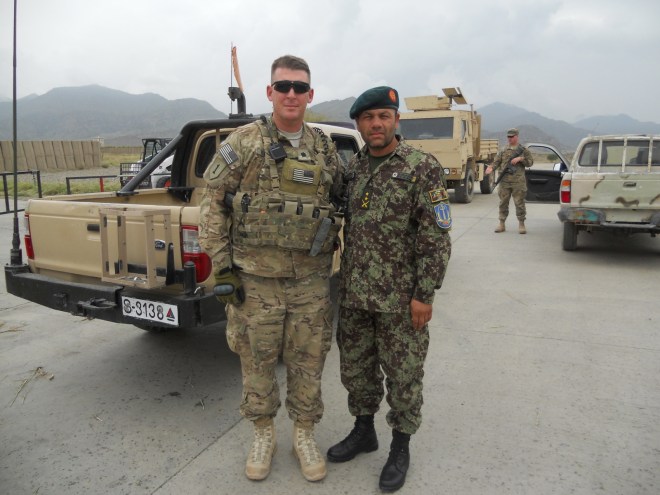
DSCN0503As the Trump administration moves forward on, or perhaps we should just say towards, its strategy for Afghanistan, the various tribes of the foreign policy and political establishment seem no closer to consensus than they have been since at least 2008. In our sixteenth year of war the lack of consensus indicates a lack of understanding and should stand as an enormous caution to all of us. On Thursday Sameer Lalwani published Four Ways Forward in Afghanistan, and this morning, on Memorial Day, the New York Times Editorial Board weighed in with The Groundhog Day War in Afghanistan. Michael G. Waltz published No Retreat: The American Legacy in Afghanistan Does Not Have to Be Defeat in War on the Rocks two weeks ago. Obviously the Times goes into less detail than Lalwani or Waltz, but nevertheless makes a clearer case. Perhaps inadvertently, the Times articulates in its penultimate paragraph the key, and insurmountable, difficulty while Lalwani chooses to ignore it when it is too inconvenient.

Lalwani’s four ways forward will be familiar to anyone who has responded to a staff college essay prompt–Statebuilding, Reconciliation, Containment, and Basing. He argues that the strategies are distinct, and indeed mutually exclusive. While each may contain elements of the others, he is correct that the United States has vacillated between the four and consequently failed at all. Strategy requires, as Lalwani states, “an honest appraisal of costs, risks, and priorities.” In fact I would reorder his list. The first concern is priorities–what end is non-negotiable or at least paramount. For which end would you sacrifice the others? In one key observation he notes that Statebuilding is incompatible with Basing, a factor with which military planners have been unwilling to grapple throughout our forever wars. Hamid Karzai’s maddening anti-Americanism was a political necessity for any Afghan politician aspiring to popular legitimacy.

Priorities, of course, can change once we determine the costs and risks. It may be that our first priority is unachievable at an acceptable cost, and this is particularly likely when engaging in a civil war in a remote and culturally alien country on the far side of the world. Afghanistan is strategically valuable for two reasons–it provides a base of operations in a volatile region where we have little presence, and it has the demonstrated potential to harbor and even nurture anti-western terrorists. Both of these advantages are real, but neither is unique or fundamentally necessary. The first is necessary only if we feel a compelling need to directly influence events in the region through military force. Accepting the limits of U.S. power in a remote area is also a viable option, though fraught with its own costs and risks. Salafist terrorists have found plenty of nurturing safe havens elsewhere since 2001, and so preventing them from using Afghanistan is of dubious value.

Statebuilding is the most ambitious of Lalwani’s suggestions, the most costly, and presents the highest potential payoff. In the minds of military planners, it achieves both of the above strategic objectives, but that is because they look at it in military rather than political and cultural terms. Lalwani himself falls into this trap, and it is worth quoting his implementation prescription to see the error:

The state-building strategy would deploy U.S. troops down to the brigade or battalion level to guide and mentor Afghan units and to signal an enduring commitment to the Afghan state. Retired officials have also argued that keeping troops in the fight will better ensure political support for aid to Afghanistan.

It is not always wrong or unwise to take things out of context. Sometimes when we are reading a long piece for the entire meaning we miss the small, specific errors that undermine the whole. Here it is obvious–Lalwani’s “statebuilding” is really security force building, and we’ve been doing that for at least seven years. It hasn’t worked because security forces are an organic part of a state and culture–they cannot be built separately, or at least good ones cannot be built separately. To build a state through the security forces means that you will end up with a militarized state, if you can do it at all. In 2014 I sat in a briefing in which the International Joint Command proudly announced that a particular kandak (battalion) had been trained to fire its howitzers. My battalion partnered with that same kandak in 2011, and we also trained them to fire their howitzers. In between, they had come apart due to poor leadership, recruiting and retention failure, a disastrous supply system, and a total lack of training management. The problem was not teaching a discreet group of Afghans to use a particular weapon, but rather trying to build a 20th century industrial army in a state that did not incorporate any of the cultural, educational, or political prerequisites. Deploying advisers down to brigade level will improve the planning and operating capability of those brigades as long as the advisers remain. It will do nothing to root out corruption, patronage promotions, rampant illiteracy, or any of the other fundamental problems.

Michael G. Waltz’s May 12 essay in War on the Rocks, No Retreat: The American Legacy in Afghanistan Does Not Have to Be Defeat, assumed the statebuilding strategy, and therefore was able to do a better job articulating the costs and risks in the space alloted. However, Waltz also assumed away crucial considerations in his otherwise clear-eyed argument for a full commitment. Waltz predicts that Secretary Mattis and Lieutenant General McMaster will successfully articulate to the president that “the key ingredient to that approach is time — most likely decades” without addressing the domestic political strategy that must accompany such a commitment. He goes on to say, “it took the Colombian government over 50 years to get to this point in its struggle with the FARC and it was arguably more advanced in its capability than the Afghan government,” without acknowledging such a precedent is likely to make the strategy politically infeasible. Waltz might argue that the president should sell the policy, but in reality he is banking on the disconnect between the military and the public. Put simply, Waltz and other advocates of statebuilding assume that a president can pursue a decades-long military and political commitment in Afghanistan, at a cost of hundreds of billions of dollars and an indeterminate number of U.S. lives, and the American people will not care enough about the Afghan war or the continued drain on the U.S. military to impose meaningful political costs. That is an open question, but counting on voter apathy leaves the president and the strategy vulnerable to a spectacular event that suddenly focuses attention.

Waltz is also more detailed than Lalwani in his examination of Pakistan’s role and the problems it creates, but he once again glosses over the fundamental problem. Waltz notes that no modern insurgency with external sanctuary and support has ever been defeated, and he argues that the U.S. government must be more coercive with Pakistan in order to gain compliance. Pakistan has calculated that the destabilization of Afghanistan and a friendly Pashtun insurgency dependent upon Pakistani largesse are in its interests. It is difficult to see how the U.S. can change that strategic calculation in the near term without destabilizing Pakistan, and Waltz’s ideas for applying pressure all run that risk. Waltz acknowledges the risk while continuing to view the situation through an Afghanistan lens, but that is the problem. We must be very clear here–no outcome in south Asia is worse than the collapse of the Pakistan government. Pakistan is a state of over 200 million people, roiling with sectarian, economic, and cultural tension, and in possession of nuclear weapons. Its government and military are corrupt, and they have fostered religious extremists as a means of maintaining internal power and destabilizing their neighbors. While tiptoeing around the Pakistan government and security forces may seem like rewarding bad behavior, it is the least bad of a set of very bad options. There is zero chance that a destabilized Pakistan government would be replaced by something better, and a high probability that it would be replaced by anarchy, civil war, an Islamist dictatorship, or some combination of the above.

Waltz does deserve credit for addressing one fatal flaw in U.S. policy to date. In arguing for U.S. advisers down to the tactical level and greater U.S. “enabler” support, he acknowledges that such a move will entail greater risk, particularly of “green-on-blue” attacks. My own experience in Afghanistan bears this out. In fact our risk-avoidance in this area is one of the clearer indicators of our lack of seriousness and the hollowness of our rhetoric. Because the U.S. military has been unwilling to accept friendly-fire casualties, we have imposed extreme measures to protect the advisors who integrate with Afghan units. Those measures raise the cost (in total personnel and mutual trust) and therefore reduce the total capability. Looked at tactically, the decisions make sense. Green-on-blue attacks gain media attention and pose the greatest near-term risk to domestic support for the Afghan mission. Viewed strategically they make no sense at all. Just over 150 coalition troops have been killed in green-on-blue attacks over more than 15 years of war. Green-on-blue attacks therefore represent a smaller proportion of deaths than accidents and suicides. To be blunt, a military operation that is not worth 10 deaths per year is probably an operation the United States should forego. If the mission in Afghanistan is truly necessary for American defense, then we should be willing to accept a doubling or trebling of the green-on-blue casualties without a thought. The perception that we are not willing to accept it is precisely the reason we should question the political will to embark on a decades-long statebuilding enterprise.

On reconciliation, Lalwani hits the key point–a reconciled Afghanistan in unlikely to be friendly or helpful to the United States. Looking at our two strategic advantages, an Afghan government that incorporates Taliban leaders would almost certainly devolve a great deal of local control. Pashtun leaders in Kandahar, Helmand, and elsewhere would be just as likely to provide safe haven to Salafist terrorists as the Taliban government was in the 1990s. Moreover, they would continue to make more. Such a government would almost certainly provide safe havens for the Pakistani Taliban, thereby ramping up regional tensions. No Taliban-inclusive government can be expected to permit continued U.S. presence. It is difficult to see what the U.S. gains from “deep reconciliation” or how we can achieve “shallow reconciliation” as Lalwani describes it. The Taliban has shown little willingness to surrender regardless of losses, and they are currently advancing in their key territories. A few thousand American advisers will not fundamentally alter that calculus, at least not for very long.

Basing presents a tempting target for U.S. military planners who, to their credit, view Afghanistan in the broader regional context. We cannot reiterate enough–Afghanistan itself is of no value to the U.S. Unfortunately, military planners tend to see the world through the lens of military plans and either wish away the political and cultural factors or leave it to others to “set the conditions.” Bases do not exist in a vacuum. They must be both supplied and defended. Afghanistan provides the ability to put U.S. assets in close proximity to the “‘Stans,” Pakistan, and eastern Iran–a tempting capability. The problem is keeping those bases secure and supplied. A reconciled Afghan government is unlikely to permit them. An Afghan government that permits them cannot gain the legitimacy it needs to be an independent state–you cannot build your independence on obvious dependence. As much as the planners at CENTCOM may want Afghan bases, they tend to ignore the problems of keeping Afghan bases, and more importantly the problems associated with losing the Afghan bases when/if the wheels come off.

That leaves us with only containment. The dangers of Afghanistan are not that great that we cannot contemplate withdrawal. Indeed, the greatest risks are political–a U.S. president must be the one to “lose Afghanistan.” This is where we run headlong into the great tragedy of Trump and Trumpism. Had the president been more knowledgeable and better advised, he could have railed in the campaign against the “stupidity” of the previous administration’s surge and continuing commitment. He could have attacked President Obama not for pulling out but for failing to pull out fast enough. Then as president he could have continued the withdrawal while holding out delays as an incentive for desired behavior by the Afghan government. Afghanistan presented Trump with an opportunity for a bold foreign policy move that would have fit within his campaign message and divided the foreign policy establishment. A precipitous Trump withdrawal would have outraged the neocon wing of the Republican Party, whom he outraged anyway, and placed Democrats in the awkward position of either arguing for continued military engagement in Afghanistan or supporting Trump.

The greatest tragedy of all, however, is the inevitable rehashing of this argument down the road. We do not have to “lose” in Afghanistan unless we choose to. The United States has ample power to maintain a presence and stave off total defeat in and around Kabul without massive U.S. casualties or a budget-busting investment. It is doubtful that we have the capability to “win” in any meaningful way (a subject for another post), and so staving off defeat just prolongs the inevitable and leaves the most painful choice for a future president. Barrack Obama, a model of maturity and responsibility, nevertheless kicked the can. Donald Trump, a model of immaturity and irresponsibility, squandered a unique opportunity to turn Afghan withdrawal into a political win and is unlikely to take upon himself the costs of withdrawing absent some obvious and immediate payoff. Let us hope, then, that we have this conversation in 2020 as part of electing the next president, rather than in 2021 as that new president weighs the long-term and unquantifiable benefits of an Afghan containment strategy against the immediate and painful costs.
Review – Why We Lost: A General’s Inside Account of the Iraq and Afghanistan Wars

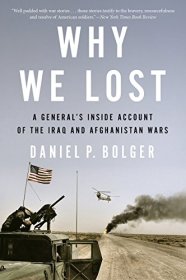
BolgerWhy We Lost: A General’s Inside Account of the Iraq and Afghanistan Wars by Daniel Bolger. Kindle Edition, 565 pages. Published November 11, 2014 by Mariner Books. ASIN: B00KEWAP04

I first published this on Goodreads back in 2014. Someone recently liked it, and the notification caused me to go back and reread it. I’m a little proud of it, so I’m republishing here.
 

LTG Bolger’s review of the wars in Iraq and Afghanistan is disappointing. The title is a bait and switch–promising an examination of the strategic failures of these two wars but offering largely anecdotes of ground-level combat. The stories of the battles are told in greater depth and with more personal observation by those who actually fought them. Bolger commanded large organizations in both Iraq and Afghanistan, and his reputation within the Army combined with this book’s pre-publication media blitz led me to hope for a serious insider discussion of the strategic choices that left us where we are today.

Instead, Bolger offers, to the extent he has a thesis at all, a recapitulation of the Weinberger-Powell doctrine of quick, decisive force with a clear exit stategy. The prescription is appealing to those who experienced the euphoria of the quick, Gulf War “victory,” but it fails to address our continued tendency to land in wars that do not fit neatly into our preconceptions. Bolger even acknowledges that the Gulf War “victory” was a strategic illusion. If so, then his preferred method of warfare failed to achieve its political ends. Bolger, like so many U.S. security pundits, does a great job of identifying the failures in our post-Cold War strategy without offering any real insight into how to do better.

The U.S. today must deal with a frustrating paradox: we are the wealthiest country in the world and expend more resources on defense than the next 14-15 countries combined. All things being equal, we would expect to be superior in whatever military arena we choose to emphasize. This is an extremely effective strategy for deterring conventional threats from rival nation states. However, we cannot expect any adversary to challenge us in our arena of greatest strength. Developing overwhelming capability in conventional military operations will not eliminate opponents; it will drive our opponents to employ asymmetric techniques like flying IEDs and people’s war. The more effective the U.S. military is at conventional warfare, the less likely we are to engage in conventional warfare. Asymmetric means are very costly to our opponents, but a few will still be willing to employ them, particularly when their survival depends upon it.

Despite our preparation and predilection for maneuver warfare, we have ended up confronting asymmetric threats in Vietnam, El Salvador, Lebanon, Iraq, Afghanistan, the Philipines, Bosnia, Kosovo, Somalia, Pakistan, and Yemen. We have been successful where opponents have failed to maximize their strengths against our weaknesses. We have largely failed where our opponents have proven resilient, persistent, and used safe havens. It is all well and good to say we should not engage in nation-building that might lead to counterinsurgency, but our repeated failure to heed that advice requires us to either embed it in our political process or rethink our strategy, doctrine, manning, and equipping.

Modern conventional warfare requires few people and lots of expensive technology–largely due to choices the United States has made about equipping and training our forces. Our conventional forces are roughly equal or even greater in capability to the “special forces” fielded by other nations or by our own in the past. Even the United States cannot maintain both a very large military relative to our population and equip/train it to the levels we have come to expect. Superbly competent infantry have proven invaluable in tactical counterinsurgency just as superbly competent combined arms formations facilitated the rapid overthrow of Iraq. However, the size of our military, particularly the ground forces, has continually limited our reach and therefore our capability to control populations–the essential function of counterinsurgency. Manning a larger ground force at the current levels of training and equipping is prohibitively expensive in the absence of more significant threats than we currently face.

We have two reasonable courses of action going forward, but each involves significant tradeoffs.

We can continue on the current road of high-tech mastery. It will cost us a lot of money and leave us without an effective means to control foreign populations over long periods of time. If we build a national strategy around defending U.S. territory and vital national interests and leaving the rest of the world to muddle through their internal issues, this could work. It will frustrate those who do not differentiate between amounts of military power and types of military power. Recent history indicates we will continue using our superb hammer to drive screws with predictable results.

We can taper off our addiction to high technology. Paradoxically, this may position us better for some future great power war. We could start day one with lots of room for growth and lots of R&D but few sunk costs. Currently, we have enormous sunk costs and had better hope that we bought the right stuff. We have not demonstrated much capability for adapting quickly after the shooting starts. With less money spent on hardware, and I would argue additional tapering on per-person personnel expenses, we could afford a larger military that would be perfectly adequate for defending U.S. territory and vital interests, provide adequate manpower to occupy other countries if necessary, and remain more connected to the civilian population. It would NOT deliver lightning fast and bloodless victories in future Desert Storms. We would pay in casualties to some extent because we would be fielding a military of adequately-equipped citizen soldiers rather than superbly equipped/trained operators. Ask the guys in the Huertgen Forest how that can turn out.

LTG Bolger never really addresses the strategic paradox that put us in this position in the first place. If he is willing to stand up in the public square and loudly oppose future military operations to shape the world to our liking in the absence of existential or at least deadly serious threats, I will stand right there beside him. If not, then perhaps the problem lies not only in our decisions to fight such wars but in the institutional military’s refusal to prepare for them.

Here is one area of praise for the book. Bolger lays squarely on the general officer corps the responsibility for not arguing the case against the Iraq invasion and the Afghan nation-building. He essentially calls his fellow generals moral cowards as a group. Unfortunately, he undermines his own point by praising individually nearly every general he names. Only David Petraeus comes in for anything approaching personal attack. The other generals are all smarter than the press gave them credit for. They all see clearly (even though they see differently). When they fail it’s because they were too trusting or too honest. He conspicuously avoids naming those generals who deserve particular and unmitigated condemnation. Likewise, Bolger finds admiration for some of the less savory characters of the wars. He praises COL Mike Steele and implies that he was treated unfairly. Bolger clearly loathes the rules of engagement imposed in both Iraq and Afghanistan, but he completely fails to address the historical precedents–we tried unfettered strikes and high collateral damage in Vietnam. How did that work out? He acknowledges war crimes by various lower-ranking U.S. service members but either poo-poos them as mostly harmless shenanigans (Abu Ghraib) or emphasizes the tremendous pressures that must have led good-hearted American boys and girls to such lengths (Mahmudiah, Haditha).

Why We Lost essentially argues that we lost because we played. Bolger praises the courageous efforts of American service members and junior to mid-grade leaders. He condemns the general officers as a body (though not individually). In the end, however, he offers no path forward. To the extent he hints at a prescription, it is one that has been tried and found wanting. The U.S. has become the indispensable nation. Too many political blocs within the U.S. are unwilling to simply accept a world that does not conform to our desires. Unless that culture changes in the near future, the military will have to build itself for the world in which it lives–not the world in which it would like to live. Incompetent and purely evil opponents will not line themselves up in countries with U.S. ally neighbors and offer to fight us mano-a-mano. The last guy who did that ended up on the end of a rope.

Review – WAR

JungerWAR by Sebastian Junger.
Kindle Edition, 297 pages Published May 11th 2010 by Twelve (first published 2010) ASIN B0035II95C

Sebastian Junger’s WAR is the best encapsulation of America’s wars at the dawn of the 21st century from the soldier’s point of view. Period. I never experienced the sort of intense, sustained, infantry combat that Battle Company fought in the Korengal, but I saw enough to hear the ring of truth. Junger did what so few are willing to do–he patrolled, ate, slept, crapped, and smoked with infantry privates and sergeants, on the ground, in the worst place on earth for a year. Long enough that they trusted him. Long enough that he learned their language. Long enough that he began to understand their stir craziness, fear, love, anger, and apparent derangement that was really sanity.

Junger’s prose is perfect for the story he’s telling–simple and unadorned. Sentences like these boil the infantry war down to its essence: “Wars are fought with very heavy machinery that works best on top of the biggest hill in the area and used against men who are lower down. That, in a nutshell, is military tactics, and it means that an enormous amount of war-fighting simply consists of carrying heavy loads uphill.”
 
In portraying the attitudes of Battle Company’s soldiers, Junger captures the combined political ambivalence and personal camaraderie that so confuses and angers observers back home. War supporters want veterans committed to the abstract goals of war and willing to sing the neoconservative siren song. War opponents want victims, duped into a stupid war and used up as cannon fodder. Neither is satisfied. Junger captures the reflexive support for fighting common among frontline soldiers. How can you continue to fight for a lie when you’ve seen your brother ripped to pieces by an RPG? At the same time, soldiers on the ground have little patience for the political posturing of the world’s Dick Cheneys. They know exactly how badly things are going on the ground. They know that “turning the corner” generally means walking into a well-laid ambush. They know that support for the government is not rising among remote villagers who may not even know there IS a government. Junger refers to Vietnam moments: “A Vietnam moment was one in which you weren’t so much getting misled as getting asked to participate in a kind of collective wishful thinking.” Explaining why men continue to fight when they have no deep commitment to the cause, Junger writes, “collective defense can be so compelling — so addictive, in fact — that eventually it becomes the rationale for why the group exists in the first place.”
 
That, in the end, is the horror of war. It takes people from a wealthy, comfortable, civilized country and debases them to tribal warriors living in squalor so they can dominate and control tribal warriors who were born into squalor. Just as the Afghan mujahideen have adapted ancient methods of warfare to incorporate RPGs and rockets and cell phones, American soldiers with all their technological marvels still become primitive beings, driven by deeply rooted instincts that evolved to protect itinerant hunter gatherers. Technology does not civilize war–if the fight is serious enough, even enough to threaten both sides, then it will inevitably devolve into a kicking, biting, scratching melee in which no one is any more civilized or merciful than any other. 
 
Junger does not so much capture new insights about war as brilliantly tell them in the context of the Afghan war. We have known throughout history that soldiers fought for their brothers beside them, that fear of showing weakness or letting down the tribe drives courage more than ideological commitment. We have known for millennia that small bands of determined guerillas can stop an army in its tracks. Junger captures the most recent version of these eternal truths in a tightly packed love letter that should be consumed by every aspiring second lieutenant and every gung-ho politician itching to send someone else’s sons and daughters to a fight. This is what you’re signing up for. There is nobility in the fighting, and sometimes it has to be done, but do not embark on it with a light heart. Do not believe that the men and women who do the hard, dirty work in distant valleys will come home unscathed. Do not convince yourself that every death will be noble and every sacrifice justified by the outcome. Junger does as good a job of telling the soldier’s story as any other author.
 
Read this book.

The Challenges of the “Warrior Ethos”

As the Army continues its struggle to imbue a “warrior ethos” while simultaneously battling suicide, PTSD, disciplinary infractions, domestic abuse, and the like, it raises a question as to whether the Army’s senior leaders have considered the implications of their paradigm. Historically, the warrior is not a disciplined team member, but a killer seeking individual glory. Achilles sulked in his tent when he felt he did not receive appropriate recognition. Medieval knights tilted in the lists. For most of human history, armies were composed of either the general citizenry or, more often, mercenaries and the scrapings of jails and slums. These mass armies served as the pawns of generals or the backdrops for individual heroes. “Warrior” cultures were not noted for their disciplined and humane armies. Armies of citizen soldiers were not particularly “warrior-like.”

Until 1945, the U.S. generally opted for the citizen-soldier model during wartime and recruited oppressed or undesirable individuals (often recent immigrants) in peacetime. The Cold War experimentation with peacetime conscription upended the model–the U.S. never became a true nation-in-arms because too few served, but neither could the common soldier be ridiculed and marginalized because the legitimacy of selective service rested on the perception that it was egalitarian in its reach. Moreover, the greater citizen participation in the armed forces, the more outside actors intruded upon training, doctrine, etc. Discipline and doctrine had to reflect the values of society because soldiers had families who did not want their sons treated harshly.

The other armed services have generally avoided the Army’s identity crisis. The Air Force has been a technical service since it gained independence in 1947, an ethos fostered by the domination of bombers and later missiles. The swashbuckling fighter culture of the Army Air Corps days maintained a niche but did not overwhelm the service culture. The Navy has always based its identity on superb seamanship. The most interesting case is the U.S. Marine Corps, a service that ought to suffer the greatest challenge to a unique identity, but instead represents the clearest individual identity of any service.

The Marines could easily have become confused based on their status as a land-based force within the Department of the Navy. Instead, they have forged a unique identity almost devoid of outside references. They do not feel obliged to define themselves as “warriors,” “citizen soldiers,” or any other generally understandable category. They are simply, Marines. They are more than sui generis; they have become a reference point for others–a category to which others aspire and refer.

The question the Army must face, is whether it can appropriate the term “warrior” for its own ends without importing the baggage that comes with it. Given the video-game culture rampant within the ranks of younger soldiers, this may be difficult to impossible. One might apply the term “warrior” to the Greek hoplites, but he must also apply it to Viking raiders, Huns, samurai, etc. It is difficult to appropriate only the toughness and courage of the traditional warrior without his indiscipline, individualism, and ruthlessness. It is not an accident that gangs frequently view themselves as “warriors.” If the “warrior ethos” cannot separate its desirable traits from its undesirable, then is there another that better fills our needs, or better yet, is it possible to forge a unique identity free of outside references? Can the American Soldiers be the symbolic equivalent of the U.S. Marine?