Conservatives are Coming to Terms with White Christian Nationalism

Democrats have had a tough year–a really tough year. Much of the struggle resulted from the decision to count on demographic change and the awfulness of Donald Trump to deliver the White House for Hillary Clinton with little regard for Clinton’s weakness as a candidate and the realities of polling. Democrats, if they wish to regain a governing role and move the country toward a more progressive future need to figure out a coherent platform that grows and stabilizes the middle class while protecting the progressive gains of postwar America.

Republicans, on the other hand have appeared to have a great year. They continue to control the majority of statehouses and governorships. They have the appearance of a decisive majority in House of Representatives and managed to retain a slim majority in the Senate despite an unfriendly election map. But Republicans don’t seem particularly joyful about their victory and with good reason. Taking back the White House under the banner of Donald J. Trump is at best bittersweet for Reagan’s acolytes. The House majority has so far proven itself unable to pass important legislation without caving to Democratic pressure–the House majority rests on three dozen or so recalcitrant “conservatives” who retain their seats by voting against every bill and trash-talking the House leadership. This morning’s New York Times Opinion section offers a cautionary note for the GOP in three articles by conservatives and religious commentators. R.R. Reno, editor of First Things, urges Republicans to embrace nationalist ideology as their touchstone to replace Reaganite small governance. Robert P. Jones, chief executive of the Public Religion Research Institute, details the collapse of a unifying American ideology into two opposed, and perhaps irreconcilable camps and Katelyn Beaty, editor at large for Christianity Today, takes conservative Christians to task for their reflexive defense of powerful men who harass and assault women, . Each is interesting in itself, but taken together they tell a story of current power without a clear path forward and with potentially dire implications for the country as a whole.

Reno quite correctly points out that middle and working class Americans have abandoned the Democratic party and the Reaganite core of the Republican party because they sense that they “no longer count,” and Reno lays that blame firmly on both parties. He does not, however, explicitly acknowledge the historical arc that he himself articulates. He begins with the observation that, “Over time, however, that iteration [Buckleyite small government] of Republican conservatism became less salient, in large part because it won.” Later he tells us, “The once vast and unifying middle class has eroded over the last generation. Today we are increasingly divided into winners and losers.” He fails to draw the straight line between those two statements. The “last generation” that saw its wages stagnate and its place in the middle class erode was the generation that grew up during the full fruition of Reaganite taxation and spending policies. A 35-year-old today who cannot find steady employment with a pension and health insurance was born in 1982. Even more telling, Donald Trump outperformed Mitt Romney in counties that skewed older–in other words with the voters who moved to the Republican party in droves in 1980 and 1984 but never saw prosperity trickle down as they were promised. Reno places the blame for that stagnation on globalization and blames both parties for embracing it, but he does not even acknowledge the correlation between the implementation of laissez-faire tax and labor policies and the collapse of the working middle class. For Reno, the answer is an overtly nationalist politics that rejects multiculturalism and globalization for policies that explicitly benefit Americans. The question he implicitly raises and fails to answer is what those policies might be. Republicans have told us for generations that unfettered free markets are the only economic system that builds generalized prosperity. Is he now rejecting that philosophy and asking us to trust its proponents to embrace its opposite?

The more pressing worry that Reno’s prescription raises is the uses to which such a governing philosophy is likely to be put. He offers no coherent economic theory to employ in his America First philosophy, and history tells us that populist economics, whether from the right or the left, rarely lead to generalized prosperity. When they fail, the alternatives are obvious and dire. Robert Jones tells the story of the parting of American philosophy–the abandonment of a nation built on a shared ideal in favor of one built on two irreconcilable world views. In one, associated with both the New Democrats and the Republican corporatists, ethnic and religious diversity, free trade, and commitment to a global commons are admirable goals, purely beneficial and even necessary for our continued functioning in an interconnected world. Opposed to this view are the white Christian conservatives who feel increasingly threatened as they move from majority to plurality to minority. White Christians are demographically threatened from both directions–minority races and ethnicities continue to grow as a percentage of the overall population while fewer and fewer Americans align themselves with organized religion. The combination of white Christian nationalist politics with the shrinking percentage of white Christians in the population raises an obvious danger. If the GOP forms a winning coalition of white Christian traditionalists today, how do they function in a few years when white Christian traditionalists are no longer a majority or even plurality? Do they willingly surrender their political power to opponents who espouse diametrically opposed values? History may not provide clear answers, but it furnishes plenty of warning signs. We see the future today in states like North Carolina and Texas, in which the non-white, non-Christian, non-traditionalists populations are growing. The reigning party responds with ever more extreme gerrymandering, voter suppression, and red meat legislation to hang onto power. Further, it is difficult to envision how a national politics that benefits white working-class voters can fail to benefit minorities and non-Christians unless the GOP completely guts the federal court system. Perhaps GOP nationalists will not demand that it do so, but that is unlikely. Perceived advantage is far more powerful than absolute prosperity. Republicans have historically been disappointed by Supreme Court justices, most recently John Roberts, who fail to be completely partisan once they reach the highest court. A court dominated by Republican appointees will certainly prove more conservative than it might otherwise have been, but it may not be willing to transform the United States into a white nationalist state. Pending cases regarding state support for religious institutions will provide an interesting test, but the court may not be willing to privilege Christian institutions as overtly as GOP constituents would like, and that could place states in the position of funneling public dollars to mosques and temples as well as churches, or reversing themselves completely on the blending of church and state.

Which brings us to Katelyn Beaty’s challenge to conservative religious communities’ tendency to rally around powerful men and forgive their sins while blaming their victims. Combined with the conservative embrace of overt nationalism and the declining demographic share of white Christians, the evangelical propensity for, “insular organizations that resist external checks and revolve around authoritative men” is exceedingly dangerous. When faced with scandalous behavior by their charismatic leaders, and Beaty catalogues a disturbing but merely representative sample, these organizations too often defend institutions and leaders rather than their professed values. They have shown an obscene willingness to blame powerless victims for their victimization, as when John Piper claimed that, “‘a lot of Christian women are oblivious to the fact that they have some measure of responsibility’ in managing men’s lust.” Organizations that are already predisposed to easily forgive the sins of powerful white men while blaming women cannot be expected to restrain the uglier tendencies of white Christian nationalism in the face of rising demographic challenges. Moreover, without a functional economic model that improves the lives of their core supporters, they will ultimately face a choice between admitting failure or distracting the disappointed. In advocating a turn to nationalism, R.R. Reno does not argue that its protectionist rhetoric will work economically, only that globalist economics have not worked for the middle and nationalism is popular. Beaty’s criticism of evangelical leaders–and indeed we have examples from other faith communities as well–point to an explosive destination for the current trend of conservative policies.

The short history of the Trump administration to date indicates a continuation of white nationalist rhetoric, sops to conservative Christian voters on hot-button issues, and economic policies that continue the consolidation of wealth and reinforce the power of large corporations and the financial industry. Advocates of nationalism like R.R. Reno had better look long and hard at what they’re advocating and consider how it ends. Their criticism of the real effects of globalization are accurate up to a point–the point where they have to accept the role of conservative tax policy–but that doesn’t make nationalism any more appealing or viable except in the immediate electoral sense. To those jumping on the white Christian nationalist train, beware you don’t burn down the country to win an election.


Review – Alexander Hamilton by Ron Chernow


HamiltonAlexander Hamilton by Ron Chernow
Kindle Edition, 860 pages. Published March 29, 2005 by Penguin Books. ASIN: B000QJLQZI


These are notes for a review of Ron Chernow’s excellent biography of Alexander Hamilton. Beginning in my last Afghanistan tour, I became interested in the evolution of U.S. foreign policy. What did the founders really think, and how did they act. I had an embarrassingly weak grasp on the early years of our republic and reading time on my hands. I’m not sure why I never completed the Chernow review–perhaps it coincided with my redeployment and I just got busy. At any rate, here are the notes, and I will endeavor to flesh them out if I get the time.


Hagiography

hostile and unfair to Madison

Not as much speculation as Madison and Washington biographies, but still too much–especially as it pertains to his relations with Eliza.

Decline as he aged.  More conservative, more fearful.

Gouvernor Morris’s odd post-mortem claim that H favored monarchism

Interesting parallels to D.P Moynihan (October Atlantic)

Comparison to Reagan Democrats–baby boomers for revolution in their youth who transition to reflexive conservatism in their middle age.

Clear effects of the personal losses he suffered on his outlook.  Chernow’s claims regarding whether H was or was not suicidal are highly suspect.

Ultimately, Chernow is reluctant to admit that Hamilton after 40 was not Hamilton before 40. He became a less important, less bold, and ultimately less effective leader as he took greater council of his fears. Given a largely free rein by Washington, he operated boldly and brilliantly. Challenged and distrusted by Adams, out of government (mostly), and with most of his grandest ideas implemented, he slipped into partisanship for the sake of partisanship and personal animosity. Emphasize the 18th C party as cult of personality.

Donald Trump and Fourth Generation Politics

I wrote this in February but never published it. I was job hunting at the time, and one of my interviewers had a Donald Trump cookie jar on his desk. This didn’t seem like the sort of thing I needed on the web during a job search. Two months later I’m still job hunting, but I do not want to work anywhere that will expect me to stop analyzing the world as honestly as I can.


Before any discussion of the election, we should stipulate to one fact–it was a damn close thing. 79,646 votes in 3 states tipped the race. That’s 79,646 out of 128,824,246 or roughly .06% of the votes cast. It would be unwise, then, to draw too many sweeping conclusions or any conclusions that are too sweeping from these results. No one event put Donald J. Trump in the White House. Had the FBI not interjected on two occasions, had Hillary Clinton built an impregnable firewall between the Clinton Global Initiative and the State Department, had the Russian security services not hacked the DNC and campaign e-mails, we might be listening now to Donald Trump’s fevered rantings about a rigged election (oh, wait….).

The more interesting question, however, is what would have happened without Trump’s perceived own goals? What if he had NOT been caught on tape in that bus with Billy Bush? What if he had NOT attacked Khizr and Ghazala Khan? What if he had NOT attacked a federal judge for his ethnic heritage? There is no question that some of Trump’s perceived liabilities were real liabilities–his many bankruptcies and the Trump University lawsuits undermined his core narrative of business genius and straight talk. The victims of Trump University were exactly the sort of voters Trump needed to win. His outrageous statements and tweets, however, may have been an asset. Plenty of people have looked at how they were received in Trump country, generally focusing on the remarkable extent to which his supporters failed to care. What we haven’t really studied is how they affected the Clinton campaign. Did they draw the Clinton campaign into some of the classic failings of counter-insurgents?

As Donald Trump moved from one outrage to the next in the summer of 2016, it is understandable that Hillary Clinton’s highly conventional campaign targeted his offensive statements and turned their resources to ensuring that as many people as possible were aware of and outraged by Trump’s statements about women, Latinos, Muslims, African-Americans, and others. Barack Obama had won two consecutive presidential elections by building a coalition of various identity groups and by running a remarkably competent and efficient campaign that mastered the blocking and tackling of 21st century politics. Many observers, myself included, believed that Hillary Clinton would win the election by energizing the various elements of the Obama coalition and then doing the basic manual labor of voter turnout in the key swing states during the voting weeks. Trump showed no signs of understanding, let alone mastering, the mechanics of modern elections. While turning his ground game over to the Republican National Committee might have been smart outsourcing in some elections, it placed the party in an awkward position in key swing states with candidates for the Senate and House distancing themselves from the presidential candidate. How could the party turn out the swing voters it needed to retain the Senate without those same swing voters undermining Trump? In the end, of course, it didn’t matter. 79,646 voters in three states turned the tide, and GOP Senate candidates in all three states retained their seats, even Wisconsin’s Ron Johnson, judged the most endangered candidate of the election.

Those of us who have spent the past decades fighting Islamic insurgencies in Iraq and Afghanistan can apply some of what we’ve learned to understand one of the reasons Hillary Clinton failed. As Donald Trump offered up softballs in the form of open mic recordings, 4 am tweets, and disastrous debates, the Clinton campaign began focusing their efforts on highlighting Trump’s own words. In the first debate, Clinton laid an obvious trap for Trump by awkwardly bringing up Alicia Machado out of seeming thin air. Trump appeared to walk straight into the trap–signaled by the obvious non-sequitur–and Clinton’s campaign promptly dumped their carefully prepared opposition research on the airwaves. From the beginning of the Democratic convention to election day, Clinton banked on the power of identity politics and uniting various groups in a sufficiently large coalition to overcome the shrinking pool of white, male voters.

Mao famously stated that the revolutionary is a fish who swims in the sea of the people. Insurgents blend into the population because it faces counter-insurgents with a painful choice between two evils. If the counter-insurgent strikes the insurgent within the population, he causes collateral damage, killing innocents, destroying homes, and increasing sympathy with the insurgent. He creates opportunities for the insurgent to show his concern for and connection with the people. In Lebanon, Hezbollah differentiates itself from the government with extensive, efficient, prompt, and legitimate social services. The Muslim Brotherhood and its various offshoots and imitators have always maintained a symbiotic relationship between their social services and their political/military arms. In Baghdad, the Office of the Martyr Sadr provided food aid to those who attended Friday sermons, sermons favorable to the Jaish al Mahdi militia and the Sadrist movement.

If the counterinsurgent chooses not to strike, then he faces a different set of problems. He cedes the people to the insurgent who lives openly in defiance of authority. The government looks weak while the insurgent looks fearless and strong. If the insurgent holds a rally in public without response from the government, then his authority challenges the government’s. If the insurgent dispenses justice through “revolutionary courts,” the swift decisions paint a glaring contrast with the tedious and often corrupt proceedings of the official courts. Because the insurgent is not bound by the rule of law, he can play both sides by impeding official courts, through intimidation of witnesses for instance, and then dispensing swift and effective justice from his own courts.

By attacking women, Muslims, Latinos, the disabled, and others, Donald Trump may have been employing the insurgent handbook, albeit without having ever read it. When faced with the Hobson’s choices above, too often counter-insurgents choose to hit the targets they can hit, simply to show that they’re doing something. In Iraq, Sadr City housed over 2 million people, but it was effectively inaccessible to both Iraqi government and foreign forces. Coalition targeting was guided first and foremost by accessibility. There was no sense worrying about targets we could not reach. Every once in a while that played to our advantage when senior leaders’ tolerance for risk increased and changed the ground rules. In the spring of 2008 with Sadrist forces firing rockets into the Green Zone and the airport, the powers-that-be accepted the risks of a series of strikes judged too costly before. Over three days in May we struck three times, the last with six MLRS rockets as close as 30m from a hospital, and the Jaish al Mahdi leaders fled Baghdad. For a brief moment, we gained an advantage, but then we failed to press it home.

Hillary Clinton’s campaign was prepared to fight a policy election. She posted hundreds of carefully crafted and vetted proposals that addressed real issues. Because she had decades of policy experience and a competent, experienced staff, the proposals were coherent and feasible. She went out of her way to ensure they were all paid for through some means or other so Republicans could not attack her for wild deficit spending. Her policy portfolio had the strength of realism but lacked the strength of simplicity. Because these were real policies to deal with complex, difficult problems, there was no way to reduce them to sound bites.

Donald Trump frustrated the Clinton campaign by failing to produce any policies. He literally disbanded his embryonic and understaffed policy shop. Not one of its products ever made it to Trump’s mouth or the campaign website. To the governing professionals of the Clinton campaign and the college-educated voters of the cities, Trump’s policy desert seemed like a glaring weakness, but it presented a challenge. Every time Clinton proposed a carefully constructed policy, Trump responded with an unsubstantiated claim that his policy would be better. Clinton could not attack Trump’s “tremendous, beautiful” policies, because they didn’t exist. She couldn’t compare the costs of his policies because they were too vague to score. The Mexican border wall presents the clearest example. Building a wall between Mexico and the U.S. is a laughable excuse for an immigration policy. Clinton was quite right to point out that it did not address the way illegal immigrants come to the U.S. today, that border walls have been frequently defeated in other countries, and that the wall would be difficult, if not impossible, to build and very expensive. Trump responded that he was a builder (as if that somehow overcame the laws of physics), that his wall would be bigger than other border walls (as if the others had failed because they were too short), and that Mexico would pay for the wall. He never settled on just how high his wall would be, so it was impossible to demonstrate that the height would not make a difference. He never addressed the issues of terrain or land ownership that will impede the wall. And most notably, he never explained how he would get the Mexicans to pay for a wall they oppose.

Clinton’s campaign, faced with a shifting set of simplistic, squishy soundbites in place of a policy portfolio decided instead to attack the available target–Trump’s character. Unable to fight on the ground of their choosing, they launched missiles at the targets that presented themselves. Here is where the counterinsurgency analogy is useful. It is quite possible that those 79,646 voters did not see Trump attacking a Gold Star family. They saw him attacking a Muslim man with brown skin and an accent. They were disturbed and uneasy about the encroachment of multi-culturalism into their formerly lily-white lives, and Clinton’s attacks on Trump seemed to be attacks on them for feeling uneasy. If you don’t want to press 2 for English and you want to be surrounded by people who share your values, your language, and your heritage, then you are racist, she seemed to say. Those of us who live in multicultural urban areas understood her perfectly, but Trump voters were the sympathetic civilians blown up by the airstrike. She was attacking their view of themselves, and that just made them more defensive.

Insurgencies succeed because of cultural affinity. Successful insurgents manage to convince a sufficient number of people that the insurgents share their values and concerns while the ruling elites are aliens. Ethnicity and religion form the most effective cultural glues, but sometimes economics or other markers can suffice. The Clinton camp made the mistake of believing that Donald Trump, billionaire, could never forge a strong enough bond with white working class voters to get him over the top. They failed to understand that Donald Trump, Kentucky Fried Chicken eater and inarticulate spouter of jingoistic platitudes, felt far less alien to those voters than college-educated urbanites steeped in the language of multicultural cosmopolitanism. By striking the targets of opportunity–Trump’s offensive speech–Clinton failed to do the hard work of forcing Trump to fight on policy grounds. Rather than force him to defend his misogyny (the very word screams “liberal elite”) she might have forced him to articulate a plan for health care, or at least made him pay for his lack of a plan.

So when and how do insurgencies fail? Some fail because the government manages to align with the people. It addresses their legitimate grievances while drawing the insurgents into undeniable atrocities. People begin to blame the insurgents for their miseries and for blocking the government from improving their lives. Often, the very identity factors that aid some insurgencies play against others. For instance, the British counterinsurgency in Malaya provides a rare example of a foreign power defeating a large-scale insurgency, but the Malayan insurgents were nearly all ethnic Chinese. They were just as alien to the bulk of the Malayan people as the British, and in this case the impermanence that often defeats external counter-insurgents played to the British advantage. By the time of the Malayan emergency, the British Empire had crumbled, and a British victory was almost certain to lead to independence. A rebel victory, on the other hand, seemed likely to lead to permanent rule by Communist ethnic Chinese.

Unfortunately, insurgencies most often fail after they succeed. The prime tools of the insurgent are chaos and disruption–anathema to actual governance. Successful revolutions nearly always result in purges because the best revolutionaries are incapable of governance. Sometimes, as in Algeria, the purge happens before the revolution is won as ruthless leaders send the true revolutionaries out to die in the final battles, leaving the field clear for post-war reconstruction. In the Soviet Union, the ruthless dictatorship of Lenin gave way to the Stalinist terrors, and Mao followed up his successful revolution with decades of murder and chaos.

The Trump campaign seems, however, to bear more resemblance to the Arab revolt. The first two weeks of the Trump presidency look more and more like the scene in Lawrence of Arabia after the Arabs take Damascus. That leaves people concerned with governance another Hobson’s choice: hope for Trump to get his act together so he doesn’t drag the country down into chaotic dysfunction, or hope Trump fails utterly so he doesn’t drag the country down into an authoritarian dystopia. Which you choose depends on just how dangerous you thing Trump really is.

Starting Over

I’ve blogged intermittently for a few years now. As a serving military officer, I was constrained in what I wrote for publication, even on a blog that nobody was reading. In the past year or so I’ve used the platform primarily as a repository for book reviews, and I’ve use the book reviews primarily to remember what I’ve read and what I thought about it. Middle age does terrible things to the memory.

Now that I’m retired, I feel the urge to speak more freely. This blog will serve at a minimum as a vent for the thoughts clogging up my head–as a way to sort through mental impulses and first impressions and turn them into coherent ideas with proper sourcing. I will need to discipline myself to think ideas through and critique them before they come out.

It will also serve to put first drafts out where others can see and critique them. Consequently, it’s important to note that this blog may contradict itself from time to time, or even frequently. It may include half-assed thoughts that seemed clear and well-supported when I typed them. If I subsequently think better of them, or if readers (aw optimism) convince me I’m mistaken, I will endeavor to publish corrections in the same venue in which I published the original error.


Review – Spain in our Hearts: Americans in the Spanish Civil War, 1936–1939

Spain in our Hearts: Americans in the Spanish Civil War, 1936–1939
by Adam Hochschild,
Hardcover, 464 pages. Published 2016 by Houghton Mifflin Harcourt. ISBN: 978-0547973180

“…if you were against Hitler and Mussolini before Dec. 7, 1941, you were a premature anti-fascist.”
-Representative Martin Dies, House Un-American Activities Committee

HochschildAdam Hochschild notes that many American veterans of the Spanish civil war proudly embraced Dies’s intended slur. Standing alone, it seems to blame those prescient enough to see the danger of fascism and to absolve Americans who either looked the other way or, like Torkild Rieber of Texaco, actively supported European right wing extremists. Hoschshild’s recounting of American involvement in the war, not only the volunteers who joined the Spanish “Republicans,” but also the Roosevelt administration’s deliberations and dithering, the American press coverage, and the response of American businessmen like Rieber, makes clear that the case was more complex than the veterans of the Lincoln and Washington battalions would have us believe.
One cannot write in the 21st century about the Spanish Civil War without acknowledging the genocidal brutality of the Republicans’ Soviet sponsors alongside the unquestioned awfulness of the “Nationalists'” Nazi and Fascist allies. In Hochshild’s telling, the American liberal idealists who flocked to the Republicans were willfully naive while the Nationalists were actively engaged in the international fascist project. As we read of the early Nationalist atrocities toward captured Republicans–even those not actively involved in resisting Franco’s coup–the gang rapes, immolations, and random mass executions, it is not difficult to fall in line with Hochshild’s evident sympathies. He acknowledges atrocities by the Republicans but argues they happened primarily in the early chaos of the coup and that the Republican authorities (such as they were) quickly put an end to them.

More damning, in some ways, is his portrait of the utopian incompetence of the various Republican factions. Catalonia, in particular, was dominated by anarchists with no viable plan for creating a government. Various communists, socialists, anarchists, and liberals all wished to defeat the military regime, but that about summarized their agreement and cooperation. While the Nationalists agreed on their ends and united under a coherent chain of command, the Republicans agreed only on what they were against, and not even on why they were against it. As the international arms embargo generated a widening gap between Nationalist and Republican capabilities, only the Soviet Union provided weapons and trained military personnel to the Republicans, with an attendant increase in Soviet influence within the Republican command. Because the civil war corresponded with the great purges and show trials, Soviet agents inevitably transferred Stalin’s paranoia to Spain. At one point, Soviet advisors chose to use ineffective tank tactics because the more effective tactics were the brainchild of a recently purged general, and no Soviet advisor was willing to create a pretext for suspicion.

When the U.S. civil war broke out in 1861, 26% of West Point graduates who would go on to serve in the war transferred their allegiance to the Confederate States. Because that cohort included tactical and operational geniuses like Stonewall Jackson and Robert E. Lee, the rebel forces were able to achieve spectacular early victories while the Union muddled through with less competent generals. In the end, though, about 65% of serving West Point graduates, including strategic masters U.S. Grant and W.T. Sherman, fought for the Union. The system of congressional appointments had quite intentionally ensured the geographic distribution of professional officers, and when the geographically-based civil war came, each side retained its share of military talent.

European class-based societies–and none was more class-based than Spain–faced a completely different dynamic. The power of the nobility and upper class was entirely predicated on military prowess, and the ranks of the military officer corps were closed to anyone outside the upper class. In 1936 Spain still had one foot planted firmly in the middle ages, and the deep and profoundly conservative roots of the Catholic Church did not improve matters. When the break came, it occurred between the reactionary forces seeking to preserve the old order–the military, the nobility, and the church–and the modernizing forces seeking to yank Spain quickly into the imagined utopia of 20th century communism, socialism, or anarchy. As a consequence, the “insurgents” included all of the armed force of the Spanish nation–military and police, equipment and trained personnel.  Moreover, the reactionary Nationalist forces were far more unified, untroubled by the ideological divisions that never ceased to undermine the Republican side. Franco’s unchallenged professional superiority along with a few convenient deaths of potential rivals ensured the rapid consolidation of Nationalist forces under a single authoritarian leader. The availability of the Army of Africa, Spanish colonial troops entirely dependent on the Army for their families’ livelihoods and with no cultural ties to the peasants of the Spanish countryside or the petite bourgeoisie of the Spanish cities, provided a reliable force of trained soldiers with little probability of desertion or shirking. Inexplicably, the Republicans never employed the single (though dubious) tool at their disposal for splitting the loyalties of the Moroccan soldiers–a pledge of Moroccan independence in the event of a Republican victory.

It is easy to identify parallels in the conduct of the war and the civil war raging today in Syria, and those parallels raise disturbing questions. The Assad regime is perhaps the equal of Franco’s Nationalists in its brutality toward its own people and its willingness to destroy any possible source of opposition, though equaling Franco’s most appalling tactics may be beyond even Assad. The Syrian opposition is a ragtag group of ideologically fractured groups, dominated by the most radical element–communists in Spain and hard-core Islamic jihadists in Syria. Both oppositions relied on a flow of naive and ideologically committed foreign fighters, and both employed those foreign fighters in similar ways, as shock troops in the forefront of the most costly battles. While we have tended to look at the Lincoln-Washington veterans as admirable idealists, we see the jihadists as murderous and stupid. Without in any way defending the foreign fighters of Daesh, it is not hard to see the same thirst for adventure and youthful restlessness in many of the Spanish volunteers that we see in Muslim youth flocking to Syria. It is difficult to remember now, but many of the American volunteers in Spain were fleeing the same sort of dead-end, alienated lives that Belgian and French Muslims are fleeing today. In 1936, young Jewish men (and they were disproportionately Jewish) from America’s cities were unlikely to be employed, married, or to have any good prospects. Fighting in Spain was a safety valve that drained off not only the most ideologically committed, but also the most risk-tolerant.

The comparison raises a challenging ethical question for the United States as we watch such conflicts emerge around the world. When is it morally justifiable to support one side in a conflict, even if that side is either likely to lose (badly) or likely to be undesirable itself in the event of victory? Hochschild concludes plausibly that the Soviets would have found it impossible to dominate a victorious Republican government without the credible threat of military occupation and distracted, to say the least, by World War II. Perhaps, but the seeds of authoritarian rule were scattered throughout Spanish political culture and not just among the Nationalists. Soviet advisors and commissars had nurtured those seeds throughout the war, and the Republican factions engaged in intramural violence at several points. While a Republican government might not have been Soviet-dominated in the mold of East Germany or Poland, there is no reason to assume it would not have been authoritarian in the vein of Castro’s Cuba. All such discussion is almost certainly a philosophical exercise, because the Republican’s never possessed the material or strategic wherewithal to win. It is doubtful that the Republicans had a chance from the moment the Army of Africa began landing in Spain aboard German aircraft.

If the western, and particularly American, failure to support the Republicans is less damning that it first appears, the private support from American businesses is not. Texaco in particular facilitated the Nationalist victory in ways that not only circumvented the U.S. position of neutrality but also constituted corporate fraud. Texaco’s president, Torkild Rieber, sold Franco over $20M worth of oil on long credit, the equivalent of ~$325M today. So enamored of the Nationalists was Rieber that he transported the oil in Texaco-owned and leased tankers free of charge without bothering to tell his board of directors–a direct subsidy and unquestionably fiduciary malfeasance. Lest we grant Rieber the same pass for naivete that we grant the Republican volunteers, he continued to show his partiality for European fascism long after it could be even generously excused. He continued to sell oil to the Nazis as war approached and even traveled to Germany as a guest of Hermann Goering after the invasion of Poland. He also facilitated the work of at least one German intelligence agent who worked out of the Texaco headquarters. Nazi sympathizers hired by Texaco funneled coded shipping information to German intelligence to assist in the sinking of ships bound for Britain. Exposed, Rieber resigned from Texaco with a large pension and went to work for Franco as a lobbyist for the Spanish oil monopoly. During a 1938 visit to the Spanish front, Rieber had noted that only Ford trucks were in use by the Nationalist forces. He commented that he should ask Walter Chrysler why he too was not “doing something for civilization.”

The Spanish civil war presented one of those international situations where there are challenging, problematic options; terrible, abhorrent options; and “neutrality” will itself constitute aid to one side or the other. It is unlikely that U.S. aid (or British or French aid, or all three) would have tipped the scales for the faction-ridden and amateurish Republicans. It is probable that a Republican victory would have led to a government either incompetent and weak, or authoritarian and communist, or both. It is reasonable to believe that the influx of international fighters, including the Americans, provided badly needed manpower to the Republican side and thereby prolonged a doomed war and added to the overall suffering. It is undeniable that the Nationalist government and the subsequent Franco regime were an historic abomination, proudly guilty of mass murder, mass rape, torture, forced labor, and reactionary repression. With the exception of highly organized industrialized genocide, there is no Nazi outrage of World War II that was not rehearsed in Spain. Moreover, the Spanish civil war provided German and Italian forces with a vital testing ground for equipment, tactics, leader training, and logistical organization that contributed directly to early Axis victories. American sympathizers and American inaction in Spain aided and abetted the most dangerous and morally repugnant regimes of the 20th century. The Lincoln-Washington volunteers bear only the most tangential blame for Soviet crimes and the failures of the Spanish Republicans, but Torkild Rieber and his fellow travelers are directly implicated in the deaths and abuse of hundreds of thousands of Spaniards and of the Nazis’ millions of victims. Those of us who advocate for a cautious foreign policy and a hands-off approach to “problems from Hell” must bear that painful reality in mind.

Review – The First World War by Hew Strachan & The First World War by John Keegan

WWIThe First World War By John Keegan
Hardback, 475 pages. Published 1999 by Alfred A. Knopf. ISBN: 0–375-40052-4

The First World War By Hew Strachan
Hardback, 364 pages. Published 2003 by Viking. ISBN: 0-670-03295-6

Hew Strachan and John Keegan are unquestionably among the foremost British military historians of our day, and both produced single volume histories of the First World War in the years approaching the centenary. While Strachan’s book takes a more stratospheric view of the war (and consequently comes in over 100 pages shorter), Keegan relies on a number of personal vignettes and more detailed tactical and operations descriptions to tell the story–not surprising from the author of The Face of Battle. Ultimately, both books’ strengths are also their failing: the Great War ranged too far and wide, with too many disparate actors, for a single volume of manageable size to capture. Keegan’s book in particular serves as a useful jumping-off point for a more detailed study of the war, but beyond the trenches of Flanders and France and the Pripet Marshes, it merely whets the appetite without fully satisfying it. Strachan, oddly, covers the German African campaigns in greater detail. Neither does justice to the campaigns in the Middle East or Italy.

While Strachan takes a less tactical approach, Keegan’s book is more successful at tying together the various theaters into a holistic narrative–demonstrating the ways in which campaigns on the Eastern Front, in Serbia, and in Italy were tied to the central campaigns in France and Belgium. As usual, the naval war is barely a footnote.

For the student wishing to better understand the cataclysm of 1914-1918, largely overshadowed by the even greater tragedy of the Second World War, these volumes are valuable but should be accompanied by a “further reading” list covering the various campaigns ranging from the Ukraine to the North Sea and central Africa.

Why does the U.S. have such a staggering record of failure? We don’t.

I came upon this little gem this morning through a link from Doctrine Man (@Doctrine_Man) on Twitter. Harlan Ullman, Arnaud deBorchgrave Distinguished Columnist no less, points out quite accurately that U.S. military adventures since 1945 have not resulted in the sort of Appomattox/rail car at Compiegne/Deck of the Missouri moments of triumph that Americans see as the proper termination of conflict. The tidbits of causality he offers are fair and serious–imperial overreach and hasty intervention in poorly understood conflicts have not served out national interests and have led to embarrassing military debacles with inconclusive or conclusively bad results.

However, the challenge to his thesis is inherent in his murky timeline. He laments a record of failure stretching from Korea to Yemen and compares it unfavorably with our record of winning from the Civil War through the Cold War without noting that these periods overlapped by 49 years! The same administration that allowed “[p]residential inexperience and unachievable aspirations” to drag it into the Korean conflict also initiated the Cold War–unquestionably the decisive conflict of the post-1945 era and unquestionably a U.S. victory. Even Korea, though prosecuted ineptly, was hardly an unqualified failure. Today, South Korea is a prosperous, stable democracy while North Korea is a dysfunctional swamp of palace intrigue, famine, and international mayhem. One can argue that the Korean juice was not worth the squeeze (debatable) or that the U.S. military prolonged the war unnecessarily at the cost of pointless casualties and devastation (undeniable), but it is difficult to wish on the 50+ million South Koreans living in security and prosperity the miseries of North Korean citizenship.

Ullman is also too willing to see previous “successful” conflicts in purely military terms. Certainly the Union militarily defeated the Confederacy and received a clear surrender, but Confederate revanchists spent the next 11 years undermining and resisting the Union regime before fully recovering political control and imposing Jim Crow oppression. Southern legislators largely controlled the U.S. Congress for the century following the war, defeating most attempts to impose upon the recalcitrant southern states the political ends–beyond the formal abolition of slavery–for which the war was fought. Watching southern senators filibuster civil rights bills to death in the 1950s, Clausewitz might have questioned who won the war. The peace ending World War I was so badly botched that it plunged the world into a second and far more destructive conflagration within a generation. Military intervention in the Philippines initiated a drawn out, and politically unpopular counterinsurgency. Invasions of Haiti and Nicaragua hardly generated stable democracies. Even the 1990-91 Gulf War, cited by Ullman as a success, never really ended before sliding into the disastrous 2003 invasion. While it had the trappings of a clear victory, it was really a quagmire without a viable exit strategy.

Those military conflicts that qualify as clear victories pose a second problem–they are hardly among the nation’s proudest moments. The U.S. decisively defeated Mexico in 1848 and seized a vast swath of valuable territory. We fought a long and bloody war from the James River peninsula to Wounded Knee that succeeded in displacing the native people and securing the continent for European settlers, and in 1898 our trumped up war against Spain delivered Puerto Rico and Pacific coaling stations (though also that pesky Philippine insurgency).

Finally, it would be a mistake to view even military performance only through the lens of large-scale conflicts. The vast majority of U.S. military activity over the past 72 years has taken place outside the battlefields of Korea, Vietnam, and Iraq. It has consisted of the naval patrols that ensure open sea lanes, the maintenance of open skies, and the security guaranteed by the deterrence by U.S. service members stationed in Europe and Asia.

There is much to lament in the U.S. military record from 1945 to the present, but the U.S. strategic record is not nearly so dismal. During that period, the United States established and sustained the institutions that have maintained global commerce and a substantial period of great power peace. We faced down the Soviets over Cuban-based missiles and emerged without destroying the world. We generated unprecedented security and prosperity for our own people and played a major role in securing the same for our close allies in Europe and Asia. Viewed from a greater distance, U.S. military failures appear less as a series of disasters and more as unfortunate and embarrassing sideshows. That does not absolve the architects of failure, nor does it lessen the pain of those who paid the price for those failures. We should be ruthlessly honest with ourselves about our military shortcomings and substantially improve our decision-making for engaging in military adventures. We should not equate those military failures with strategic failure and sacrifice what has been successful in an attempt to improve what is, after all, only one element of our strategic toolbox.


Review – The Sling and the Stone: On War in the 21st Century
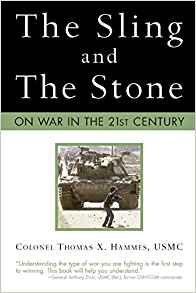
HammesThe Sling and the Stone: On War in the 21st Century
by Colonel Thomas X. Hammes, USMC
Paperback, 321 pages. Published 2006 by Zenith Press. ISBN: 978-0-7603-2407-3

Written as the Iraq war was careening off a cliff and published in 2006, just before President Bush’s decision to “surge” in Iraq, The Sling and the Stone attempts to define the next generation of warfare. Hammes subscribes to the theory of Billy Lind, Gary Wilson, et. al. that there have been four generations of modern war, each reflecting and conforming to the society that engaged in it. First generation warfare relied on line and column to mass firepower at the crucial point on a relatively confined battlefield. The second generation employed rifled, breach loading weapons, barbed wire, and other technological advancements of industrial age to culminate in the static trench slaughter of World War I. Faced with the carnage of the first war, the Germans introduced the third generation, maneuver warfare, in 1939.

Fourth generation warfare is the weapon of the weak against the powerful. In Hammes’s telling, Mao “started this form of war,” (a dubious assertion) and subsequent practitioners have modified and improved it, making use of ever-changing technology, public opinion, and the fecklessness of the superpowers that insist on fighting the enemy the desire rather than the enemy that actually challenges them.

Hammes is particularly incensed by the Pentagon’s Joint Vision 2020 and the obsession with “cyber war.” His dismissal of cyber warfare has not worn well with time, in large part because the cyber war he describes is not the cyber war that has actually evolved in the last decade. Hammes is justly critical of Pentagon planners who insist on facing a near-peer competitor armed with high-tech weaponry and contesting territory openly. Such competitors justify massive defense budgets focused on high-end gadgetry produced by giant defense contractors. They provide jobs in congressional districts and require massive bureaucracies full of patronage appointees. Unfortunately, the United States is so good at and prepared for fighting such wars that no enemy it their right mind would dare to face us on our own terms.

Since Hammes published his book, the Russians have engaged in small wars in both Georgia and Ukraine. Russian capabilities have surprised many casual observers–after allowing their military to largely collapse in the 1990s, they have rebounded with a professional, well-equipped force prepared to fight effectively with massed fires and sophisticated battlefield coordination. They are using unmanned aerial systems effectively with long-range rocket artillery to strike deep in enemy territory. But, the Russians cannot project power far beyond their borders. The Syrian war has demonstrated both their capabilities and their limitations. Their single aircraft carrier is a joke, requiring them to maintain a secure airfield within range of the battlefield if they wish to bring to bear their air force. They were able to launch a few cruise missiles, but they did not achieve the sort of effects that the U.S. military considers routine. They did not even attempt to deploy large ground forces.

Meanwhile, however, the Russians have deployed a sophisticated and deniable cyber capability that causes the western world consternation. Hammes largely dismissed the cyber threat that has actually emerged while equating cyber war to the much touted “revolution in military affairs” enabled by sophisticated command, control, communications, intelligence, surveillance, and reconnaissance. Hammes argues that the U.S. overestimates the utility of its C4ISR dominance while underestimating the resiliency and ingenuity of its likely adversaries. Here he is undeniably correct. Hammes failed to see the potential for cyber warfare to emerge as a key tool in the asymmetric warfare toolkit–cheap, concealable, portable, and scalable.

Overall, Hammes’s book fits into the library of fine studies of insurgency, counterinsurgency, and terrorism published since 2001. It is not revolutionary, but it does provide solid case studies of modern asymmetric warfare and clearly articulates why the U.S. is likely to continue facing such threats and unlikely to face the peer competitor for which it endlessly prepares.


Review – Thinking in Time: The Uses of History for Decision Makers

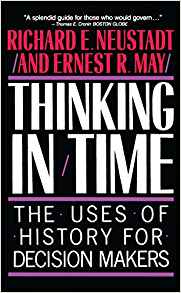
NeustadtThinking in Time: The Uses of History for Decision Makers By Richard E. Neustadt and Ernest R. May
Paperback, 329 pages. Published 1986 by The Free Press. ISBN: 0-02-922791-7

I first read Neustadt and May’s book as a student at the U.S. Army Command and General Staff College, I think on the recommendation of Dr. Mike Pearlman, but I cannot remember for sure. After 13 years and facing the prospect of a second career, I thought it prudent to revisit it. My (second) first impression was that I must have internalized much of it the first time. In particular, their “mini method” of placing both individuals and institutions. My second observation is that their methods and maxims are useful, but their examples rely far to much on hindsight. It is easy to conduct a postmortem and determine that some event in an actor’s past or some formative influence on an agency was the crucial element for understanding how that individual or agency would behave. But that doesn’t mean the same or an analogous factor will be dispositive in the next crisis.

Indeed, the authors offer a number of cautions against simplistic analogies. We see them every day in our public discourse–every confrontation with an authoritarian regime is Munich; Donald Trump is a nascent Hitler; every military intervention is Vietnam. As Jon Stewart once said, “you know who you can compare to Nazis? Nazis.”

Nevertheless, Neustadt and Mays’s techniques are beneficial for decision makers. In his speech on the role of the National Security Advisor, Stephen Hadley says it is the NSA’s role to get immediately to the question of “what are we trying to achieve” and to stay focused on it. Neustadt and May would respectfully disagree. They argue for the importance of establishing the history of an issue and of the individuals and institutions involved before diving straight to the action required. First, figure out what you know, what you don’t know, and what you presume. These steps will be familiar to anyone familiar with the military decision-making process. “Place” the key individuals and institutions within time and events. What public events shaped the decision makers’ points of view and values? The authors point to Leonid Breshnev’s history and the history of the Soviet state to demonstrate why Jimmy Carter’s early approach on significant nuclear weapons reductions was so ill-advised. In the realm of known/unknown/presumed, they single out the crisis of the “Soviet brigade” in Cuba during the Carter administration. It turned out the brigade had been there since the missile crisis, but nobody in the close decision circle knew that–they just presumed that the brigade was newly arrived.

In 2007, the red team at the 4th Infantry Division, led by then Major Mike Runey, produced one of the finest “placement” documents I’ve ever seen. Mike was a former history professor at West Point, and I have no idea whether Neustadt and May’s book influenced his techniques or not, but they fit exactly. The red team laid out the demographics of Iraq and then placed the largest demographic groups on a timeline of major events. Given Iraqi birthrates, the largest and most dangerous block of men were Shi’ites between 18 and 35. Once we looked at the timeline and realized that the formative event of their lives was the massacre of their fathers, uncles, and older brothers following encouragement and abandonment by the United States, their failure to welcome us as liberators seemed far more rational. Those young men associated Saddam’s repression of their families with American betrayal and blamed us as much as Saddam and the Sunnis.

Neustadt and May seem ambivalent on the formal study of history. They point out examples when those who study it most formally nevertheless make poor decisions while those with a more informal and general grasp of history seem to easily understand events in historical context. They attempt an awkward construct–thinking of time as a stream–to explain their thinking. The analogy to a stream is never clear or very constructive. What Neustadt and May call thinking in a stream is really about having such a firm grasp of history that you can see current events in context without relying on explicit, and flawed, analogies. The study of relevant history establishes context in the mind of the decision maker that allows him to see issues clearly, informed by history but not rigidly guided by a false expectation of repetition.

Review – Invisible Armies: An Epic History of Guerilla Warfare from Ancient Times to the Present

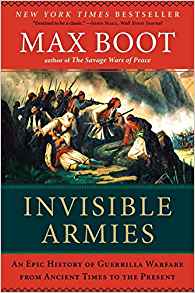
BootInvisible Armies: An Epic History of Guerilla Warfare from Ancient Times to the Present By Max Boot
Hardcover, 750 pages. Published 2013 by W.W. Norton & Co. ISBN: 978-0-87140-424-4

Max Boot attempts in Invisible Armies to construct a comprehensive catalogue of insurgency, terrorism, and revolution from antiquity to the 21st century. While his sketches are generally thin, and colored with his own neoconservative brush, the book provides a valuable encyclopedia for placing insurgencies in context. Boot’s categories are also useful as they reach beyond the normal list and challenge conventional assessments. For instance, Boot categorizes the first Ku Klux Klan as an insurgent and terrorist organization and makes a pretty strong case. Most American readers might prefer to leave the Klan off a list of insurgencies, particularly since Boot concludes they were largely successful in achieving their aims.

In conjunction with the book, Boot maintains the Invisible Armies Insurgency Tracker at the Council on Foreign Relations website (http://www.cfr.org/wars-and-warfare/invisible-armies-insurgency-tracker/p29917). The tracker, like the book, is a useful jumping off point for structuring research on insurgencies; however, the inability to download data in table form makes it more useful as a visual aid than as a tool for expanding and deepening research.