To Serve or Not to Serve

This post first appeared on the Center for Security Policy Studies blog https://csps.gmu.edu/2020/03/09/to-serve-or-not-to-serve/ on March 9, 2020.
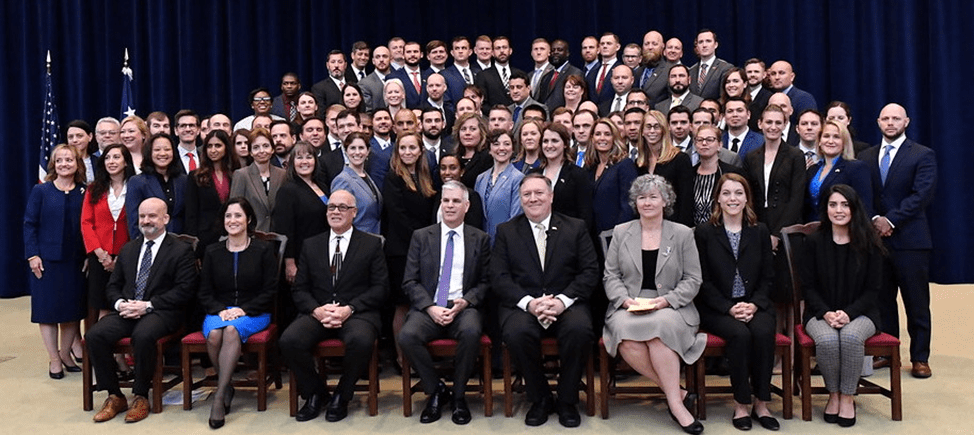
Prospective national security professionals may be forgiven for avoiding the federal government in the current political climate. Watching President Trump, members of Congress, and cable TV personalities impugn the integrity, competence, and patriotism of  national security officials does not paint a picture of a happy, fulfilling career. Disapproval of administration policies, like family separation or the President’s pardoning of accused war criminals, further discourages recruiting. Nevertheless, young people with talent, integrity, and an interest in national security should pursue opportunities to serve.

National security professionals recognized early that President Trump’s approaches to both national security and the federal workforce would pose staffing challenges. Dan Drezner wrote four Washington Post columns on the subject (see here, here, here, and here). Eliot Cohen initially encouraged people to seek positions but to “keep a signed but undated letter of resignation in their desk” to remind themselves of the requirement to identify their ethical redlines and to resign if required to violate them. He quickly reversed himself after deciding the administration would make honorable service impossible. Benjamin Wittes argued senior professional staff  should stay on to ensure high quality professional advice unless ordered to do something unethical.

What has happened in the three years since these questions began circulating?

Nothing good.

The number of applicants taking the Foreign Service exam dropped by 34% in 2017 and a further 22% in 2018. President Trump appointed a high percentage of political supporters to ambassadorships, and Trump-appointed ambassadors are removing their career deputies at an alarming rate. Career prosecutors at the Department of Justice quit the Roger Stone case in response to political pressure, and the Attorney General initiated investigations of the FBI and Hillary Clintonwhile cooperating with the president’s personal attorney, Rudy Giuliani, to produce political dirt on Joe Biden. The president personally attacked career diplomats and military officers who obeyed congressional subpoenas.

This hostile climate is exactly why talented young people of high ideals and integrity should seek careers in national security now and why more senior public servants should encourage them to do so. The most important feature of the U.S. national security apparatus is its non-partisan professionalism, while the most dangerous feature of the current administration is its disregard for the norms of American governance.

The antidote to personalization of the bureaucracy is not abstention or “deep state” resistance. National security professionals can best ensure the continuation of America’s proud tradition of non-partisan service by maintaining high professional standards while remembering Eliot Cohen’s exhortation to identify redlines. National security professionals who value our professional norms should be seeking out talented young people and recruiting them to serve.

Administration hostility is creating vacancies as more senior people choose to depart, giving young staffers opportunities to serve in responsible positions at younger than normal ages. Public service attracts people who value making a difference over personal gain, but that does not mean public servants lack ambition. Rather, their ambitions often focus on achieving good policy outcomes along with personal advancement. The former may be difficult in an administration that does not value professional expertise, but that difficulty can, paradoxically, help young staffers develop greater expertise. To have any chance of making good policy, their proposals will have to be more tightly reasoned and carefully supported than might be the case with friendlier political appointees.

Indeed, serving under a difficult administration may actually have positive side effects. New professionals can build the habit of executing policy dispassionately, at the direction of elected leaders, as well as the courage to explain and advocate policies that may not be popular with superiors. Professional staffers serving inexperienced and erratic decision-makers can unlearn some of the bad habits that their elders adopted, like presenting throwaway courses of action to limit superiors. A national security professional who begins in this environment and endures with her integrity intact is likely to be a formidable policy-maker in the future.

Finally, nobody should ever enter public service without a sense of duty, and duty does not end because the administration is hostile or incompetent. If anything, weak political appointees increase the duty of competent public servants to do their best within their ethical boundaries. Anyone hoping to have a career in national security should understand that she will have to serve in administrations with which she disagrees and under leaders of whom she disapproves. A young graduate entering public service in 1980 during the Carter administration and serving 40 years would have also served under Presidents Reagan, GHW Bush, Clinton, GW Bush, Obama, and Trump. Secretaries of State would have ranged from Al Haig to Madeline Albright. Given that broad diversity, any public servant could expect to disagree with some or even many of the people she would have to serve and policies she would have to implement. New staffers, however, have more to gain and less to lose in the current environment. Even with accelerated responsibility they will be farther from the political appointees than their more senior colleagues. Signing that letter of resignation in the desk drawer will cost them less than a mid-grade staffer who is halfway to retirement.

People who value rational, evidence-based, morally defensible national security policy can either enter the arena with their eyes open, or they can cede those entry level positions to people of lesser qualifications and greater ethical flexibility. Today is the perfect time to join, knowing that it may be a trial by fire.

The Cost of Service in a Partisan Age

This post appeared originally at the Center for Security Policy Studies blog https://csps.gmu.edu/2019/11/09/the-cost-of-service-in-a-partisan-age/ on November 9, 2019

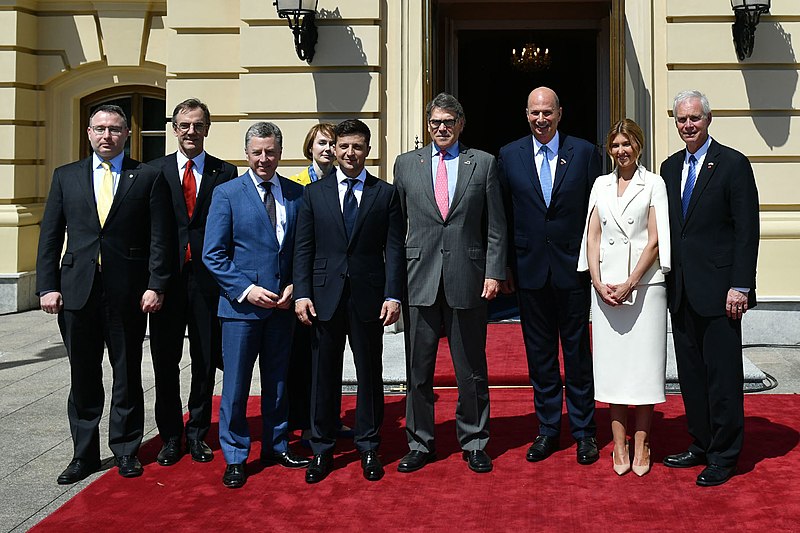
Delegation (left to right): Alexander Vindman, Joseph Pennington, Kurt Volker, Olena Serkal, Volodymyr Zelensky, Rick Perry, Gordon Sondland, Olena Selenska (First Lady), Ron Johnson at Zelensky’s Presidential Inauguration, 2019
Photo from Wikimedia Commons

The Trump administration has challenged American norms of civil-military relations. Candidate Trump signaled that he would reverse established law and attack commonly held norms when he promised to reauthorize waterboarding, and he further challenged tradition by appointing an unusual number of serving and retired generals to senior positions and referring to them as “my generals.” In this hyper-partisan environment, the military has struggled to maintain a non-partisan position. Maintaining it became unexpectedly harder last week when a serving military officer, LTC Alexander Vindman, was drawn into the impeachment inquiry, and the president subsequently attacked him personally.

Faced with this challenge, the military’s priority is to remain outside the partisan fray and maintain its position as a trusted national institution. Political actors, including the president, are attempting to use the military’s prestige to bolster their positions. This prestige, however, rests on the tradition of non-partisanship.

Decisions about when and how to go to war are inherently political because they have political consequences, but the military has traditionally provided advice on matters with political implications while scrupulously avoiding any participation, even indirectly, in the partisan contestation of elections. In a time when every question is contested on a partisan basis, every answer becomes partisan. The military must tread an extremely narrow path to fulfill its obligations without straying any further than necessary into partisan conflict.

Testifying truthfully before Congress should not be a partisan issue, but there is no way to avoid appearing partisan in modern politics. Refusing to testify is perceived as partisan by the one party; agreeing to testify is perceived as partisan by the other. Assertions that LTC Vindman could be court-martialed for testifying are far-fetched, but he has been vilified in the conservative media and will likely retire at his current grade despite his stellar credentials.

LTC Vindman’s situation presents a dilemma for military leaders attempting to sustain non-partisan norms. So far, senior military leaders have neither criticized nor defended Vindman. There are no grounds for criticizing him, but to defend him would place the military establishment in direct conflict with the president and create the appearance that the military is taking a side in the impeachment debate. For military leaders, the priority should remain protecting the military’s non-partisan legitimacy. This may, unfortunately, include tolerating unfair treatment of one of their own. Up to a point, the institutional legitimacy of the military is more important than the mistreatment of one individual.

Opponents of the president may be tempted to make Vindman into a heroic symbol of resistance. They would be wise to resist the temptation. Conservative adulation of Lt. Col. Oliver North after he testified to Congress regarding the Iran Contra Affair in 1987 reinforced the growing perception at the time that the military was closely aligned with the Republican Party, which subsequently undermined the military’s credibility and prestige. [1] 

The real test will come if the president and his supporters continue to attack Vindman publicly or attempt to take legal action against him. Retiring as a lieutenant colonel may be unfair, but it is a small price to pay for defending the norms of civil-military relations. If Vindman testifies in open hearings, the president and his supporters are likely to engage in public character assassination in order to undermine his testimony. The president has already shown his willingness to intervene directly in military legal proceedings.

Military leaders can be excused for accepting some costs to Vindman in exchange for protecting the military institution, but they cannot allow him to be prosecuted or maligned publicly by the president in a way that could make him a target. If the president pursues his standard playbook of innuendo and harassment, he will place military leaders in a lose-lose situation – either publicly contradict the president in a highly-charged partisan matter or publicly abandon an officer to be persecuted for his honorable service. The president should understand that unfounded public attacks risk reluctant repudiation by his senior military leaders, and those leaders should privately signal their willingness to do so before it becomes a public spectacle.

Senior uniformed and civilian military leaders must prioritize the military’s non-partisan integrity in a highly partisan environment, but they must realize that they risk the same dilemma as LTC Vindman. Whether he chose to testify or not, his actions were bound to be seen as partisan. Now, military leaders will face the same problem if the president forces them to choose between defending Vindman or abandoning him. The president and his supporters will view the former as partisan resistance, and Democrats will view the latter as partisan acquiescence. The president should avoid creating that dilemma, and military leaders should let him know now, before it again bursts into public view, that they too will speak truthfully and publicly if forced.

[1] Peter Feaver and Richard H. Kohn, Soldiers and Civilians: The Civil-Military Gap and American National Security (MIT Press, 2001).

Joe the Plumber and the Descent of the GOP

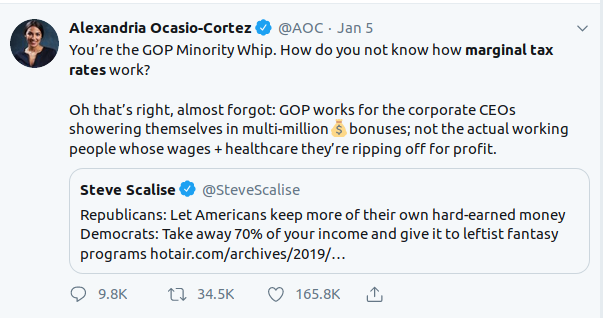
Last week freshman representative Alexandria Ocasio-Cortez set off a bit of a Twitter storm by suggesting a 70% marginal tax rate to fund her “Green New Deal.” Whether a 70% marginal tax rate would raise enough money to do so is a technical question and one I am not qualified to address in any meaningful way. Of more interest to me was the followup, in which various Republicans implied that her proposal would take 70% of some constituents’ incomes and Rep. Ocasio-Cortez shot back that they did not seem to understand progressive taxation or marginal tax rates. The exchanges jogged my memory in a way that illuminates the core problem of the modern Republican party.

In October, 2008, with John McCain only weeks away from badly losing the presidential race, Samuel Joseph Wurzelbacher confronted candidate Barrack Obama at a campaign event and challenged him about his plan to raise federal income taxes on people making over $250,000 per year. Wurzelbacher, who subsequently became known as Joe the Plumber, said he was about to buy a small business that he expected to “make” between $250,000 and $280,000 per year and Obama’s plan would make him poorer. Obama, professorial as always, delivered a brief explanation of marginal tax rates. It was not entirely clear whether Wurzelbacher meant that his business would have that amount of revenue or profit, although that level of profit for a small plumbing business would be surprising.

A poorly informed challenge to a candidate on the campaign trail is also not that surprising. The telling moment came three days later when Senator McCain made Wurzelbacher’s challenge the centerpiece of his final debate with Obama. Wurzelbacher almost certainly did not understand the difference between a flat tax rate and a marginal tax rate. His question implied flawed assumptions, and he would probably have been better off under Obama’s plan than under the then applicable tax law (https://www.nytimes.com/2008/10/17/us/politics/17joe.html). Although McCain was an expert in national security and the military rather than tax law, he certainly understood the difference. He had been in Congress for decades, and he was no dilettante, but sinking fast in his final presidential bid, he bet that his potential voters would NOT understand marginal tax rates and would react emotionally to the entirely fictional threat to raise their taxes.

McCain was famously one of the more principled members of the Senate during his tenure, and on a number of occasions he refused to participate in shameful pandering. The encounters in which he refused to humor supporters who called Senator Obama a Muslim and argued that he was therefore unfit or a security threat (http://time.com/4866404/john-mccain-barack-obama-arab-cancer/) may be the most admirable soundbites of any presidential campaign in my lifetime, but when it came to  tax policy, he was willing to demagogue and pander.

In 2008, tax cuts remained at the core of what it meant to be a Republican. McCain, to his credit, fought back against the populist xenophobia wing of his party. It certainly did not hurt that he himself suffered from it in the 2000 race when push polls in South Carolina attacked his adopted daughter (https://www.nytimes.com/2007/10/19/us/politics/19mccain.html). McCain saw that trend within American politics for the cancer it is, but he was a Reagan Republican to the core when it came to tax cuts. Tax cuts are also a technical issue, or at least they are within certain bounds. Lowering rates can stimulate economic activity and might, at some optimal level, raise tax revenues. Raising rates can retard economic activity and will most certainly prove disastrous at some level. The moral dimensions of taxation are much harder to identify. Finding the edges at which normal political maneuvering over a largely technical question begins to have serious consequences for large numbers of vulnerable people–and therefore becomes a moral question–is nearly impossible in real time. Lowering the top marginal rate from 39% to 37% is not an inherently moral question, but altering the tax structure of the country in a way that fuels massive inequality is. Whether that’s actually happened or not is a matter of debate (https://www.taxpolicycenter.org/publications/taxes-and-income-inequality/full) but to the extent it has not that is because Democrats reversed Republican tax cuts.

The point here is that GOP willingness to spout nonsense about tax cuts, assuming that their voters will misunderstand reality and reinforcing said misunderstanding, is not new and was even true of their most honorable recent candidate. Today, as tax cuts recede, at least rhetorically, from Republican centrality and are replaced by white Christian nationalism, the danger is that the habits learned from years of misleading tax debate bleed over into a topic that is ALWAYS a moral question. There is a zone of debate on immigration that is technocratic and reasonable, but we seem to have moved beyond that zone for the foreseeable future. The current GOP arguments on race and immigration pander almost entirely to a cohort of Republican base voters with hardened views. If the most honorable elements of the Republican Party apply to the issues of nationalism and xenophobia the same rhetorical methods they applied to taxes, then we are in for a very uncertain future.

Islamic State and the Sahwa

I cannot recommend too highly Dr. Craig Whiteside’s ICCT research paper, “Nine Bullets for the Traitors, One for the Enemy: The Slogans and Strategy behind the Islamic State’s Campaign to Defeat the Sunni Awakening (2006 – 2017).” For those of us who fought the war against the various incarnations of Daesh from 2003-2010, it is eye-opening to see what we did not see at the time. I personally operated in a senior targeting position with the main-effort U.S. division in Baghdad during the height of this fight, and much of what Dr. Whiteside details was unknown to me. It should not have been. We did a poor job of monitoring our enemies’ information operations and too often saw the fight in purely tactical terms–cut off the head to kill the snake. Among his other interesting ideas, Dr. Whiteside makes a plausible argument that Abu Musab al Zarqawi was uniquely unsuited to deal with the Sahwa movement, implying that his death in 2006 may have been a gift to the enemy. This dynamic played out on the Shi’a side in 2008 when we failed to kill both Arkan al Hasnawi in Sadr City and Abu Sajjad in al Rashid. Both men attempted to run their organizations from exile, creating significant opportunities and preventing the rise of more effective local leaders.

In the conclusion, Dr. Whiteside explicitly ties the resurgence of the Islamic State following the Sahwa movement to its “defeated” status now. He makes a cogent argument that recent setbacks should not be assumed to mean complete and enduring defeat. Clearly, this question is critical in light of the President’s decision to withdraw all U.S. forces from Syria.

The implication need not be that we must retain U.S. forces indefinitely. Indeed, if U.S. boots on the ground are the only way to sustain a victory over enemies like Daesh, than that would tend to argue strongly against engaging in military action in the first place. The U.S. cannot sustain a decisive ground presence forever in every place it may want to fight.

It does imply that a precipitous withdrawal without a deep understanding of the current dynamics and a strong plan to sustain gains through allies will almost certainly lead to at least a local disaster. Before U.S. forces withdraw, we should be completely clear about the strengths, weaknesses, and likely future course of Daesh, and we should determine the ways and means required to continue the momentum toward their eventual destruction as an organizing force. Such an approach, with the close cooperation of our Iraqi partners, the Kurds, and the leaders of any Syrian groups required, along with clear commitments to provide those resources going forward might go a long ways towards mitigating the understandable sense of abandonment among those who have fought alongside us, in some cases for decades.

Academic Writing Month?

I have been intermittently following Dr. Raul Pacheco-Vega’s blog on academic practice. Recently he published an entry on #AcWriMo, a concept that I had not encountered elsewhere. Apparently November is the month in which academics are supposed to commit to their writing practice by writing every day and cranking out that journal article or chapter they have been delaying for months.

Calling myself an academic seems a little pretentious when I am a first year, part time student, but the basic premise of #AcWriMo applies. Procrastination is a significant impediment to my academic and professional achievement. Even more, I live in fear that what I say and write will have no value. I may be the only graduate student who worries about being the Dunning-Kruger poster child, but I doubt it. Eventually, there is no way to know for sure except to say and write things and suffer the consequences. If I am judged a fool, it will only be because I am one–better to know the truth.

So I will commit to plunging into the deep end for the next few weeks in an attempt to build writing into my daily life, just as I would exercise or sleep. I particularly enjoyed Van Jackson’s “Nuke Your Darlings” blog in War on the Rocks, in which he chronicled the experience of writing a book on North Korea’s history of nuclear development. So, along those lines I will chronicle my own academic life for the next few weeks as I try to survive the semester and produce something of value.

Today’s endeavor was entirely quantitative methods–fighting through a long Stata problem set on single and multiple regression, and then wrestling with the model for my final project. I also spent some time downloading and cleaning the data for the project, only to realize that I was wasting my time. With so many House races yet to be called, and so much work required to clean the data, I need to wait until the calls or made or else download a snapshot at the latest possible moment to get provisional data. It was helpful to identify a good source for the data–Dave Wasserman’s working spreadsheet for the Cook Political Report. As I’m comparing performance to Cook’s Partisan Voter Index, it is best to use their raw data as well. I’ll write a little more about the project tomorrow.

Casual Lies and the Military Profession

The Wall Street Journal published an account of American soldiers fighting in Russia (paywalled) at the end of World War I to commemorate the centenary of the armistice. Leaders were unable to explain to the soldiers why they were in Archangel fighting Bolsheviks when they had been drafted to fight Germans. Things became even more tense once the Germans surrendered and supplies ran short just in time for the Russian winter.

Initially commanders did what commanders do–they assured their higher headquarters that all was going well and morale was high. It wasn’t and it wasn’t. Eventually the senior officers had to acknowledge that troops were on the verge of mutiny.

Looking back at the Polar Bear Expedition in light of yesterday’s dog and pony show on the Mexican border highlights an age old problem for militaries, one we would do well to fix. The first officer to tell his masters, uniformed and civilian, that things are going badly will almost certainly be first ignored, then relieved, and finally besmirched. Only when word gets back to the home front and politicians face angry families, or when military disaster becomes undeniable, will senior officers drop their insistence on optimism and positive news.

The WSJ story makes it clear that is what happened in Archangel. I recently rewatched A Bridge Too Far, in which the intelligence officer who predicted disaster was cashiered before the operation. Phil Klay published a brilliant reflection on his own Iraq service in America on Veterans Day that recounted the disgrace of the PSOD (read it for yourself–it is well worth the time). Finally, yesterday, we got to witness commanders on the ground assuring the Secretary of Defense, himself a distinguished combat commander, that soldiers laying wire along the Mexican border to defend the mightiest nation on earth against a few thousand tired migrants were both deriving great training value and maintaining sky-high morale. As usual, the soldiers themselves were not having it, and we are left with the uncomfortable acknowledgement that field commanders are more likely to say what their bosses want to hear than to tell the truth. That military professionals just accept this practice as a necessity of promotion (and I do not exempt myself from this criticism) says nothing very good about the military profession in America in 2018.

American soldiers are not Roman centurions and they are not the French Foreign Legion. The citizen soldiers of a democracy deserve better. Our society lavishes praise on the “heroes” who lead our military, but we collectively are not worthy of such praise if we can breezily lie when it suits us. Leonard Wong and Stephen J. Gerras identified the problem in a well-regarded paper, but senior leaders have not made fixing it a priority. We should not be surprised–everyone in a position of authority rose through the system in which casual and obvious dishonesty was required. It would be surprising if they turned on a culture that has rewarded them so greatly. The tragedy is that these are not evil men and women. In my experience, most of them are scrupulously honest in their daily lives. They do not lie to their spouses. They would not cheat on their taxes or steal a candy bar. The military has placed certain areas outside the bounds of normal rules for honesty.

We have developed a leadership culture that views positivity and optimism as fundamental characteristics of leaders, and to some extent they are. Nobody will follow a sad-sack. The danger is that it is far too easy to conflate optimism with happy talk. Telling superiors that morale is good when it is clearly not is not optimism or positive leadership–it is lying. The mutineers of Archangel showed where it leads. Secretary Mattis should never have asked a commander on camera how morale was–answering with anything short of “excellent” would have been career suicide. In asking the question, the Secretary was essentially soliciting a lie for public and presidential consumption on national television. In doing so, he signalled every uniformed leader that such casual dishonesty was not only acceptable but expected.

I should point out here that I am not assuming that morale is bad. Perhaps it is great, although I doubt it. The point, rather, is that the colonel’s answer moves us no closer to knowing the state of morale at Camp Donna than we were before the Secretary asked the question. If we ask ourselves the simple question, how would the colonel’s answer have differed if morale were good or bad, we recognize the problem. The U.S. military has been fortunate not to face an existential threat since about 1944. Since the turning points of World War II, we have faced some terrible combat at places like Chosin and Khe Sanh and Falluja, but no military leader (outside a few watch officers at NORAD) has faced a decision on which the fate of his nation hangs. Officers have been free to answer with their careers in the forefronts of their minds, knowing that the immense national power of the United States would mitigate any negative consequences. Even when troops rebelled, as they did in Archangel and on occasion in Vietnam, the consequences were unlikely to be disastrous.

Only a culture of radical honesty, fostered from the top, will overcome the cost-benefit analysis that leads officers to tell “little white lies” that in the aggregate are neither little nor harmless. When I was a young captain, my battalion commander used to say, “don’t [urinate] on my back and tell me it’s raining.” When military senior leaders start responding that way to obvious happy talk from ambitious colonels, we’ll be on the right path.

Review – The General by C.S. Forester

The General by C.S. Forester. Kindle Edition, 321 pages, Published September 14th 2017 by William Collins (first published 1936)

I picked up The General after reading several mentions that Gen (Ret) John Kelly rereads it every year to remind himself of the pitfalls of hubris and intellectual stagnation. While Gen. Kelly’s performance in civilian life has been distressing, his descriptions of the book were intriguing. It did not disappoint.

Lieutenant General Sir Herbert Curzon is the very model of a modern British Lt. Gen., at least as seen from the interwar vantage point of 1936. Curzon is courageous to a fault, ambitious, loyal, innately suspicious of education, novelty, and dissent, disdainful of the lower classes, and utterly free of self-awareness, Through stupid luck he becomes a minor hero as a subaltern in South Africa and is perfectly positioned in 1914 to rise rapidly thanks to the opportunities born of death and the search for scapegoats. A fortunate marriage, good timing, and an unshakeable belief that his duty lies in supporting his superiors in all matters and at all times results in his rapid advancement from major to lieutenant general. His willingness to blindly expend the lives of working class British men in order to uphold the honor of the empire and maintain his own reputation ensures that he advances when others are sacked.

Curzon is an amalgam of the British regulars who led a generation to their miserable deaths on the Somme and at Passchendaele, and he embodies nearly all the stereotypes that the embittered survivors harbored. It is to Forester’s credit, then, that he occasionally acknowledges both the value of men like Curzon and the lack of reasonable alternatives. Like Colonel Tall in The Thin Red Line, Curzon’s less attractive qualities are also seen as necessary. War is a hideous business, and few wars have been as hideous as the western front. Curzon’s boundless energy results in a highly trained division that is able to ship to France in time for First Ypres. His pig-headed refusal to give an inch of ground or consider the lives of his soldiers makes it possible to hold the German advance and prevent an even greater disaster. The only alternative is defeat, and Curzon mitigates his lack of humanity by invariably sharing the dangers of combat with his men. The officers whom he finds wanting are indeed more intelligent and more willing to face the reality of the war than he is, but their greater intelligence does not provide them with any better solutions to the fundamental problem.

Later, when Curzon is behind the lines commanding by telephone, his reactionary stubbornness becomes more dangerous and less defensible. The true tragedy comes when he repeatedly convinces his superiors and his father-in-law (a government minister) that the war can be one with the same techniques if only they will throw in more men, more guns, more munitions. The horror of the truth caused the generals of the Western Front to grasp instead at the illusion that victory was possible if they just did more. At one point, as civilian leaders are losing trust in the generals, Curzon stages a demonstration for visiting officials to convince them that soldier morale remains high, and then gloats without any sense of shame or discomfort that the army has put one over on the civilians. Finally at Saint Quentin, the reality hits home. Despite his best efforts, the line breaks and it seems clear that Britain will go down to defeat. In despair, he buckles on his sword and rides to the front for a heroic death only to be hit by a shell en route and badly wounded. Despite the inglorious conclusion, he retires to acclaim and comfort as a hero.

The General is a harsh indictment of the officer corps produced by the pre-war British army, and it is worth considering whether any institutional army, blessed with a long period of general peace can do better. The British generals of 1914-1918 were no more benighted than the American generals who opened the Civil War. It is possible that they were no more benighted than the 17 commanders who have led U.S. forces in Afghanistan since 2001. An officer who rises through the institutional army is unlikely, in the face of an unexpected circumstance, to acknowledge that his talents and training are insufficient to the task. To do so is an indictment of the institution that put him in a position of power and in which he has been marinating for decades. Before we condemn the Herbert Curzon’s, we would do well to ask what choice they had and whether we would do any better.

Advisers, Mercenaries, and “Authorizations for the Use of Military Force”

Loren Dejonge Schulman has an interesting piece in The Atlantic examining the proliferation of undeclared and semi-declared U.S. military deployments in light of the death of four U.S. soldiers in Niger last month. While the seemingly endless deployments to Iraq and Afghanistan garner the bulk of the public’s shrinking attention, the military has quietly dispatched thousands of soldiers to over 100 countries to “train, advise, and assist;” “build partner capacity;” and otherwise attempt to build up the forces of allies and partners so they can do the dirty work of fighting nascent terrorist and insurgent organizations without requiring large U.S. forces. As Schulman notes, “this approach has grown more popular—and for good reason: It’s seen as a sweet deal.” The embedded link is telling, pointing as it does to Mara Karlin’s article in Foreign Affairs arguing that such assistance programs, particularly when they focus solely on military capability and capacity building, at best disappoint and at worst undermine partners’ security and stability.

Meanwhile, Eric Prince is still peddling his scheme to equip an American “viceroy” in Afghanistan with a mercenary army and get the U.S. military out of the nation building business there entirely. While Hell will freeze over before I support Prince or his plan, he may recognize a problem that more conventional thinkers refuse to acknowledge. We are so dazzled by the lasers and computers and precision capabilities of the modern military that we miss its parallels with more ancient forms of martial organization.

The Industrial Revolution enabled rapid leaps in technology for general consumption, but for that very reason, the defining feature of industrial age armies was not technological dominance but rather the proliferation of cheap, simple technologies to hundreds of thousands and then to millions of soldiers. The vast size of industrial armies was both enabled and necessitated by the low cost and simplicity of military hardware. While more primitive in an absolute sense, the crossbow of the medieval mercenary was both more expensive and more technically demanding than the bolt action rifle of the doughboy. As late as the Korean war, technical disparities between the opposing sides were marginal, with the North Koreans fielding everything from long arms to jet fighters that were equal or even superior to U.S. equipment. Production capacity mattered far more than technical capability. By the 1960s, the U.S. began fielding remote sensors, night vision devices, and precision munitions that exceeded the technical capabilities of their enemies. in the 1990-1991 Gulf War, that trend came to full fruition and the U.S. with its allies was able to defeat an Army of roughly equal size with friendly casualties despite the historical advantages of the defense.

The wars in Afghanistan and Iraq have demonstrated that the trend towards technical dominance continues. While there were individual instances of intense, bloody combat (Fallujah, Wanat), overall U.S. and allied casualties have remained extraordinarily low. After 16 years of war, U.S. deaths in Afghanistan have only slightly exceeded the U.S. deaths on Omaha beach on D-Day. Small U.S. losses do not reflect a lack of lethal action but rather extraordinary capabilities in intelligence, long-range strike, and force protection. The deaths are overwhelmingly on the other side. In turn, high tech weapons require highly trained specialists to employ them. The U.S. military recruits a tiny percentage of its population–approximately 1% v. 11% in World War II–pays them quite well, and trains them for many years. In return, it expects them to serve for decades and to deploy repetitively in what are effectively colonial wars. Modern American soldiers fight without the mobilization of the population at home, without the implicit promise that they can return home permanently upon victory, without even the prospect of anything resembling victory. The advisory missions that Schulman discusses may be undertaken on behalf of corrupt, repressive regimes that rob U.S. soldiers of the soothing mantra that they are defending “freedom.” Repeated calls for national service tend to miss this fatal impediment–the country does not need anywhere near that many soldiers, and we could not train, pay, or employ them if we had them.

We may be entering a new era of warfare that looks an awful lot like an old era of warfare. Perhaps we will graft the national loyalty of the industrial era onto the mercenary compensation and expertise of the late middle ages, but I doubt it. If Eric Prince were ever to get a shot at his mercenary army in Afghanistan, you can rest assured he would not be able to man it entirely with American ex-servicemen. Market forces would drive such a force to recruit worldwide. Moreover, I know a number of retired U.S. soldiers currently serving as “consultants,” “contractors,” and other convenient euphemisms from Donetsk to Angola to the Philippines. Schulman is correct to question the legal basis and organizational ambiguity of U.S. advise and assist missions, but the problem may be far greater than simply obtaining some form of definitive, and therefore limiting, congressional authorization. It may be that “light footprint” operations are the way of the future in a world with vast technological disparities and the escalatory threat of nuclear war in almost every corner. If so, then our industrial age organization, laws, values, and processes will need to adapt.

A Message to Pershing

Yesterday Benjamin Runkle posted a short essay on the leadership lessons of George Marshall in War on the Rocks. The essay is worth reading, as is just about anything regarding Marshall, for those interested in military leadership in strategy. What stuck with me, however, was the dissonance of the framing device–the initial meeting between Marshall and his mentor General John J. Pershing in 1917–and both my own experience as an officer and much of the literature that the Army uses to teach leadership.

For those who have not read the story before, Marshall first met Pershing in 1917 when Marshall was the acting chief of staff of the First Division and Pershing was the commander of the American Expeditionary Force. Pershing was under enormous pressure to provide U.S. soldiers as individual replacements to the overstretched allies, and he correctly assessed that the best way to resist such a disastrous and irreversible course of action was to get U.S. units into the fight. His previous inspection of the First Division had not gone well, and following his second, he lit into the division commander, Major General William L. Sibert in front of the assembled division staff officers. As Runkle puts it:

The division showed little for the time it had spent in training, Pershing snapped. They had not made good use of the time, and had not followed instructions from AEF headquarters at Chaumont regarding open warfare formations. Pershing excoriated Sibert, questioning his leadership, his attention to details in training, and his acceptance of such poor professionalism.

Marshall stepped forward and challenged Pershing, even grabbing his arm to prevent him from leaving before Marshall had enumerated to him all the shortcomings in training and logistical support from Pershing’s own headquarters. Rather than crush him, Pershing admired his forthrightness and courage and proceeded to elevate him to positions of greater responsibility and authority throughout the war and beyond.

It is a great story, illustrating the importance of A. having your facts straight, B. speaking the truth to superiors, even–or especially–when they are angry, and C. valuing tough feedback from subordinates. It all worked out brilliantly as Marshall–as close to the indispensable man as it is possible to imagine–rose to be the Army Chief of Staff at exactly the moment when his talents were required to save the free world.

The problem with the story is A Message to Garcia. Written in 1899 by Elbert Hubbard, it briefly refers to Lieutenant Andrew Rowan and his mission, during the Spanish-American War, to carry a message to a Cuban insurrecto leader. It has been a perennial favorite on military reading lists at least since I put on a uniform and, I’m sure, long before then. The author’s apparent intent was to extol the virtues of initiative and determination, with which nobody could quibble. Unfortunately, the essay as written extols Rowan’s failure to ask any questions about the mission and his devotion to completion of the task regardless of the purpose, difficulties, or encompassing situation. In short, it is the opposite of the story of Marshall meeting Pershing. If Major Rowan had been the chief of staff of the First Division, he would simply have turned back to his training schedules, redoubled his efforts, and quite likely driven the men of the division to achieve Pershing’s desires regardless of,

the promised platoon manuals that never arrived and had set back training; the inadequate supplies that left men walking around with gunnysacks on their feet; the inadequate quarters that left troops scattered throughout the countryside, sleeping in barns for a penny a night; the lack of motor transport that forced troops to walk miles to the training grounds.

So which is it? Is our ideal officer the one who accepts the task with its attendant unreasonable expectations and accomplishes it without questioning the purpose or the cost? Or his he the truth-teller who challenges the general in the bubble and confronts him with the very real material challenges that his units face? It is possible, of course, that he is both. Leadership is situational. The man who sends another man to his near-certain death may be a monster or a hero depending on the time and place, but the basic premises of the two stories are diametrically opposed. In one, the subordinate accepts the mission without question and sets out to accomplish it at any cost. In the other, the subordinate challenges the leader’s expectations and insists that the general provide as much as he is demanding of his juniors.

My own experience leads me to believe that A Message to Garcia has had a far greater impact on our current Army than the story of Marshall and Pershing or the near-contemporary story of the young Dwight Eisenhower antagonizing the Chief of Infantry with his advocacy of an independent tank arm. In the mid-1990s I commanded an MLRS battery at Fort Bragg. To reduce costs, the Army decided to arbitrarily cut the number of spare parts units could keep on hand. The initiative stemmed from the Army’s periodic infatuation with commercial best practices untethered from the realities of the military. Just in time logistics was all the rage, and the Army was onboard. Units had radically different spare parts requirements–I commanded a mechanized unit surrounded by light units–and different opportunities for cross-leveling if they were stationed by themselves versus with a number of like units. Predictably, our readiness plummeted as our launchers steadily died. When I addressed the issues with my commander, he assured me that the Army knew what it was doing, and my battery–along with the other batteries–was just failing to execute proper maintenance.

A few years later new generals came along and denounced the completely unworkable spare parts policy. They changed it back to the prior method, and readiness increased. My commander had imitated Lieutenant Rowan–the Army gave him a mission and he was determined to succeed without question. I took the Marshall route and laid out the impediments to and requirements for success. Let us just say it did not enhance my career prospects.

Lest we come down entirely on the side of reasonableness, there is something to be said for unreasonable expectations. Steve Jobs was notorious for imposing ridiculous requirements on his team and refusing to accept less than perfection. There is a good chance you are reading this on an iPhone or an iMac as a result. In war, the requirements may not always be reasonable. Sometimes military leaders must order subordinates to do the seemingly impossible, and sometimes, under the stress of unreasonableness, those determined young leaders succeed. Then we write books about them. Other times they fail, and we mourn their loss or excoriate them for not speaking up in an environment where their voices were not wanted. Either way, war is not fair, and we should not expect every order given to be perfectly informed, carefully considered, and completely reasonable.

We should, however, decide what stories we will use to mold our young officers. Should they grab the general by the arm and force him to listen to their shortfalls, or should they say “yes sir” with a crisp salute and head off into the jungle? It seems only reasonable to pick one or the other.