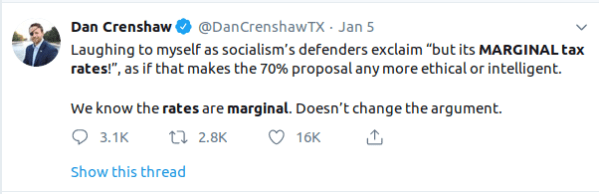
Last week freshman representative Alexandria Ocasio-Cortez set off a bit of a Twitter storm by suggesting a 70% marginal tax rate to fund her “Green New Deal.” Whether a 70% marginal tax rate would raise enough money to do so is a technical question and one I am not qualified to address in any meaningful way. Of more interest to me was the followup, in which various Republicans implied that her proposal would take 70% of some constituents’ incomes and Rep. Ocasio-Cortez shot back that they did not seem to understand progressive taxation or marginal tax rates. The exchanges jogged my memory in a way that illuminates the core problem of the modern Republican party.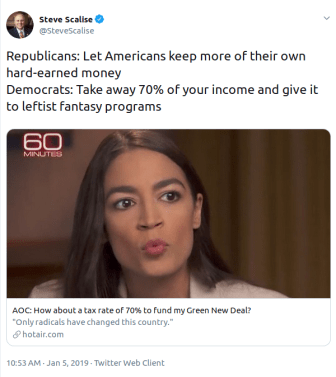
In October, 2008, with John McCain only weeks away from badly losing the presidential race, Samuel Joseph Wurzelbacher confronted candidate Barrack Obama at a campaign event and challenged him about his plan to raise federal income taxes on people making over $250,000 per year. Wurzelbacher, who subsequently became known as Joe the Plumber, said he was about to buy a small business that he expected to “make” between $250,000 and $280,000 per year and Obama’s plan would make him poorer. Obama, professorial as always, delivered a brief explanation of marginal tax rates. It was not entirely clear whether Wurzelbacher meant that his business would have that amount of revenue or profit, although that level of profit for a small plumbing business would be surprising.
A poorly informed challenge to a candidate on the campaign trail is also not that surprising. The telling moment came three days later when Senator McCain made Wurzelbacher’s challenge the centerpiece of his final debate with Obama. Wurzelbacher almost certainly did not understand the difference between a flat tax rate and a marginal tax rate. His question implied flawed assumptions, and he would probably have been better off under Obama’s plan than under the then applicable tax law (https://www.nytimes.com/2008/10/17/us/politics/17joe.html). Although McCain was an expert in national security and the military rather than tax law, he certainly understood the difference. He had been in Congress for decades, and he was no dilettante, but sinking fast in his final presidential bid, he bet that his potential voters would NOT understand marginal tax rates and would react emotionally to the entirely fictional threat to raise their taxes. 
McCain was famously one of the more principled members of the Senate during his tenure, and on a number of occasions he refused to participate in shameful pandering. The encounters in which he refused to humor supporters who called Senator Obama a Muslim and argued that he was therefore unfit or a security threat (http://time.com/4866404/john-mccain-barack-obama-arab-cancer/) may be the most admirable soundbites of any presidential campaign in my lifetime, but when it came to tax policy, he was willing to demagogue and pander.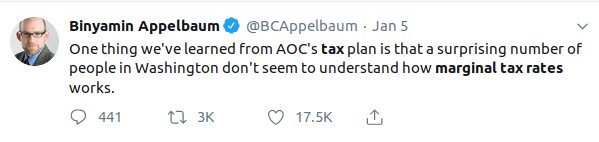
In 2008, tax cuts remained at the core of what it meant to be a Republican. McCain, to his credit, fought back against the populist xenophobia wing of his party. It certainly did not hurt that he himself suffered from it in the 2000 race when push polls in South Carolina attacked his adopted daughter (https://www.nytimes.com/2007/10/19/us/politics/19mccain.html). McCain saw that trend within American politics for the cancer it is, but he was a Reagan Republican to the core when it came to tax cuts. Tax cuts are also a technical issue, or at least they are within certain bounds. Lowering rates can stimulate economic activity and might, at some optimal level, raise tax revenues. Raising rates can retard economic activity and will most certainly prove disastrous at some level. The moral dimensions of taxation are much harder to identify. Finding the edges at which normal political maneuvering over a largely technical question begins to have serious consequences for large numbers of vulnerable people–and therefore becomes a moral question–is nearly impossible in real time. Lowering the top marginal rate from 39% to 37% is not an inherently moral question, but altering the tax structure of the country in a way that fuels massive inequality is. Whether that’s actually happened or not is a matter of debate (https://www.taxpolicycenter.org/publications/taxes-and-income-inequality/full) but to the extent it has not that is because Democrats reversed Republican tax cuts.
The point here is that GOP willingness to spout nonsense about tax cuts, assuming that their voters will misunderstand reality and reinforcing said misunderstanding, is not new and was even true of their most honorable recent candidate. Today, as tax cuts recede, at least rhetorically, from Republican centrality and are replaced by white Christian nationalism, the danger is that the habits learned from years of misleading tax debate bleed over into a topic that is ALWAYS a moral question. There is a zone of debate on immigration that is technocratic and reasonable, but we seem to have moved beyond that zone for the foreseeable future. The current GOP arguments on race and immigration pander almost entirely to a cohort of Republican base voters with hardened views. If the most honorable elements of the Republican Party apply to the issues of nationalism and xenophobia the same rhetorical methods they applied to taxes, then we are in for a very uncertain future.

 James W. Vizzard