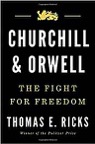
 Churchill and Orwell: The Fight for Freedom by Thomas E. Ricks. Penguin Press, 2017. ISBN: 9781594206139. 339 pgs.
Tom Ricks begins his latest book, Churchill and Orwell: The Fight for Freedom, with anecdotes about moments in the 1930s when each of his protaganists came very close to a premature death–much closer in Orwell’s case than Churchill. The future prime minister looked the wrong way stepping into a New York street, on which the cars drove on the wrong (right) side, and was nearly mowed down by a taxi. The future bard of totalitarianism stuck his head up from a parapet in Spain while backlit by the rising sun and took a 7mm bullet through the neck. Ricks begins his book this way so that he can spend the next several hundred pages demonstrating that the survival of both men mattered. Ricks is arguing here for the great man theory of history–long out of vogue–and he makes a compelling case. Oddly, his case for Orwell may be even more compelling than his case for Churchill.
In Ricks’s telling, Churchill and Orwell were distinguished and linked by their determination to see the world as it is (Orwell more than Churchill) rather than fit the “facts” to their predetermined theories or conform to the conventional wisdom of their “sets.” When the British ruling class was, at best, committed to appeasement and in many cases enamored of Fascism, Churchill doggedly insisted that Fascism was both evil and a looming threat. Orwell, though a committed man of the left, came to see Stalinism as just one more form of totalitarianism, no better than Nazism. Churchill too sounded, or rather re-sounded, the alarm about the threat of Soviet Communism after the Second World War–the main reason for his canonization by the American right.
To make the case for Churchill as the essential man, Ricks relies on two sequential but separate periods of his life. In the first, Churchill is nearly alone in his persistent condemnation of Nazism and his advocacy for greater preparedness. To understand the courage of Churchill’s position, it is necessary to understand his environment, and it is not a pretty picture. Much of the British ruling class, particularly the titled aristocracy, was at best defeatist and at worst sympathetic to Hitler and the Nazis. Anti-semitism was rampant, and faith in democracy was at a low ebb. Lord Londonderry and the Mitford sisters probably enjoyed more support than Churchill, who was obnoxiously strident about a problem that most people just wished would go away and be forgotten.
Appeasement has taken on a universally negative connotation in the decades since Munich, but it was quite popular at the time. Considered in context rather than with the advantage of hindsight, it is not hard to see why. Britain was barely a generation removed from the Somme, and the veterans, war widows, and orphans could hardly be expected to enthusiastically go to war on behalf of Czechoslovakia. The more inexcusable tragedy happened after Munich. Neville Chamberlain’s government was orderly and efficient, but it did not really do anything. Even after the Germans took the rest of Czechoslovakia and overran Poland, Chamberlain seemed supine. Belying the defense that Munich bought time for the British to prepare, unemployment actually rose from 1.2M in September 1939 to 1.5M in February 1940, when Britain should have been running factories 24 hours per day.
It was here, in the critical first months of the Second World War, that Winston Churchill again earned his place in history as the essential man. The collapse of France had not convinced the British appeasers and fellow travelers that resistance was necessary–quite the opposite. Churchill almost single-handedly energized the war effort, strengthened the spines of the British people through grim but stirring oratory, and imagined the strategy that would eventually lead to victory. The Prime Minister drove his generals and many of his fellow politicians mad with his meddling in various war matters, but Churchill understood better than anyone else what would be needed to win the war (as opposed to battles) and how to get it. Furthermore, Churchill’s direct intervention in many facets of war preparation was not amateurish meddling but based on his many years of careful study of the issues–as if John McCain suddenly found himself a wartime president. Ricks points out early in the book that Churchill was shockingly uneducated in numerous areas, but in history he was broadly and deeply read. It gave him an instinctive feel for grand strategy.
Churchill the strategist understood that strategic victories are not necessarily built from tactical victories. In 1940 the British were quite reasonably afraid and needed to regain their belief that they could win, so that, “military moves that did not make sense on a tactical basis sometimes were nonetheless advantageous for strategic or political reasons.” It was better to do something and seize the initiative than to sit placidly accepting attack and allowing the British people to perceive weakness and lethargy. Furthermore, Churchill understood the importance of organization and leadership and helped translate it into strategic advantage. “Military historians have long recognized that technological innovation is close to useless without carefully constructed organizational support.” Britain won the Battle of Britain because home field advantage preserved its pilots, fuel, and air time and because the British organized a very successful layered detection and defense that leveraged their strengths. It helped that the Luftwaffe, led by Goering, was virtually incompetent. While their planes and pilots were very good, they had no underlying theory of victory. They dropped as many bombs as they could, largely at random, in hopes the British would simply give up under the pounding. Churchill’s maddening obstinance was contagious, and Goering’s largely indiscriminate bombing caused massive damage and casualties but probably stiffened British resolve.
In the end, Churchill was right to be confident and not just because the U.S. and the Soviet Union eventually entered the war against Germany. Ricks quotes Bungay’s history of the Battle of Britain: “the margin of victory was not narrow…the Luftwaffe never came close.” Churchill could see beyond the early losses and the seeming invincibility of the German war machine to understand that invading and conquering England would be very hard indeed and probably beyond Germany’s capability–even before they invaded the Soviet Union. More importantly, he could transmit that confidence to his people so they could brace themselves for the trials to come and resolve to do what they must.
Where Winston Churchill was a larger than life figure before World War II–difficult to ignore even in the political wilderness–George Orwell was a decidedly more modest presence. He had published a number of rather bad novels and one very good book about his time in Spain. That book, Homage to Catalonia, plus his membership in one of the Trotskyite factions in Spain, had marked him among his fellow leftists. Ricks, ever the journalist, admires both Churchill and Orwell because they did not try to twist what they saw before them into their pre-conceived notions of how they wanted the world to be. Orwell was a standard British socialist when he went to Spain, but when he got there he saw Soviet agents manipulating the situation for the benefit of the Soviet Union, infighting between the groups with a willingness on the part of the Communists to ruthlessly suppress the others rather than cede any control, and he described it as he saw it. Consequently, he spent the war in a rather awkward position. His Spanish wound and his general ill health completely unfitted him for active service or even overseas reporting. He was no longer trusted by the socialist establishment, and he was genuinely eager to aid the war effort because he saw Nazism as the threat that it was. So he went to work for the BBC as a half-hearted and ineffective commentator.
As the United States entered the war in full in 1943, George Orwell began to rise above his middling life just as Winston Churchill descended into irrelevance. In Ricks’s telling, the Tehran conference marked a watershed for both. Churchill was relegated to second-class as the U.S. and the Soviet Union made plans for the post-war world with little concern for the wishes of their junior partners. Orwell saw the two emerging superpowers dividing the world between them and began thinking in the terms that would inform both Animal Farm and 1984. Churchill had been the essential man in 1940 when Stalin was still allied with Hitler and Roosevelt was unable to budge the United States off its isolationism. Stalin, the ultimate realist, knew that British wishes were of small concern to him, and Roosevelt was determined to end colonialism, even at the extent of his wartime allies.
The most important aspects of Orwell’s life were packed into six short years. His first wife died, leaving him with a young son in the midst of the war. He wrote Animal Farm and finally alienated the entire British left who saw it as a direct assault on Stalin and the Soviet Union, which they still supported. His longtime publisher, Victor Gollancz, refused to publish it. Tellingly, he had also declined to publish Homage to Catalonia, which marked Orwell’s initial break from the socialist herd. In their sheeplike devotion to Soviet Communism, the British socialists were as craven and complicit as the British aristocrats had been in the 1930s regarding Nazism. It is probably some measure of the true popularity of hardcore socialism in Britain that Animal Farm sold out almost immediately, achieving a level of popularity that Orwell’s earlier works had never approached.
By the end of the war, Orwell was a very sick man, staving off tuberculosis. As his health declined, he worked frantically on two projects–finding a new wife and step-mother for his son and completing his dystopian novel of a future under totalitarian rule. He acted somewhat paranoid, believing Communist agents might be trying to kill him. The Soviet archives opened up decades later revealed that he was, in fact, on a kill list in Spain, but it is unlikely the Soviets would have killed a British subject in Britain at that time. Though visibly dying, Orwell managed to complete both his masterpiece, 1984, and his essay on “Politics and the English Language,” cementing his reputation as a writer and his influence on the post-war world.
It would have shocked people of the time to hear it, but Orwell is probably a more significant figure than Churchill in terms of his influence on the modern world. Churchill’s dogged resolve, inspirational rhetoric, and ultimately successful organization of Britain’s defense in the early days of the war made it possible for there to be a post-war world, but once the U.S. and the Soviet Union entered the war, Britain was primarily important as an unsinkable staging base off the coast of Festung Europa. Ricks notes that Churchill’s oratory became less stirring and more confusing as the war carried on. The Combined Chiefs paid less and less attention to his suggestions and desires. Age, fatigue, and drink all took their toll. When he finally faced election for the first time in 1945, he lost and faced the indignity of turning over Downing Street to Clement Atlee while the war was still going on. Churchill enjoyed a brief renaissance as an early prophet of conflict with the Soviets and crafted another of the many felicitous phrases that have embedded him in the English language–the Iron Curtain–but his second turn as prime minister was embarrassing. He was built for the moment of crisis and fulfilled his role beautifully. The world he made possible did not really need his gifts or have room for them.
Furthermore, it is somewhat misleading to laud Churchill as the champion of “freedom” without a very large asterisk. As Williamson Murray points out in his own review in War on the Rocks, millions of Asians and Africans (not to mention Irish) in former British colonies might find the idea very odd indeed. Churchill was the champion of British independence and the freedom of the English, Scottish, and Northern Irish to live under a particular form of self-government. He did not share Orwell’s much greater commitment to universal freedom of conscience and self-governance.
Orwell, by creating a fictional portrait of totalitarianism that was both vivid and accessible, became the poet laureate of the Cold War. Just as Churchill understood early that the Soviet Union was both monstrous and a threat to the West, Orwell too saw the erstwhile allies for what they were. While Animal Farm attacked the Soviet Union as it was and had been, 1984 presented the picture of what all societies could become if they gave in to the forces of totalitarianism. The most terrifying aspect of 1984 is not the surveillance or the suspense or the torture but rather the final sentence. Orwell understood that the deepest threat of totalitarianism was not its coercion but the tendency of ordinary people to embrace it.
Orwell’s vision of a dystopian future embedded itself into western culture. Even in the Soviet Union smuggled copies proved a powerful driver of resistance. His essay on the misuse of language in politics became a seminal tool for teaching the abuse and misuse of English to mislead and obfuscate. On this subject Ricks makes one of his rare misstatements, claiming that, “Less noted about the essay is that it isn’t simply against bad writing, it is suspicious of what motivates such prose.” That aspect has not gone unnoticed at all. It is what distinguishes Orwell from Strunk and White or any other guide to good writing. Indeed, there are serious problems with the essay as a guide to style, but as an expose of the techniques of political misdirection it is unmatched.
Tom Ricks has made a powerful argument for the very real impact of two individuals on the course of history. While large, impersonal forces ultimately made possible the Allied victory in World War II, its outcome would have been very different if the British had reached a separate peace in 1940. Had Churchill been run down by that New York taxi, it is difficult to see who would have fulfilled his role in the 1930s–certainly nobody of his talents or determination comes to mind. It is equally difficult to see how the British would have withstood the pressure to surrender without Churchill’s inspiration. Likewise, Orwell was unique among committed leftists in combining a clear-sighted understanding of the evils of Stalinism with the literary acumen to help others see it. Orwell was not a necessary factor in the West’s Cold War victory, but he was a useful implement for galvanizing the determination of western peoples to persevere and to resist Soviet propaganda.

 James W. Vizzard