Spain in our Hearts: Americans in the Spanish Civil War, 1936–1939
by Adam Hochschild,
Hardcover, 464 pages. Published 2016 by Houghton Mifflin Harcourt. ISBN: 978-0547973180
“…if you were against Hitler and Mussolini before Dec. 7, 1941, you were a premature anti-fascist.”
-Representative Martin Dies, House Un-American Activities Committee
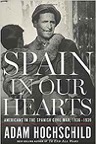 Adam Hochschild notes that many American veterans of the Spanish civil war proudly embraced Dies’s intended slur. Standing alone, it seems to blame those prescient enough to see the danger of fascism and to absolve Americans who either looked the other way or, like Torkild Rieber of Texaco, actively supported European right wing extremists. Hoschshild’s recounting of American involvement in the war, not only the volunteers who joined the Spanish “Republicans,” but also the Roosevelt administration’s deliberations and dithering, the American press coverage, and the response of American businessmen like Rieber, makes clear that the case was more complex than the veterans of the Lincoln and Washington battalions would have us believe.
One cannot write in the 21st century about the Spanish Civil War without acknowledging the genocidal brutality of the Republicans’ Soviet sponsors alongside the unquestioned awfulness of the “Nationalists'” Nazi and Fascist allies. In Hochshild’s telling, the American liberal idealists who flocked to the Republicans were willfully naive while the Nationalists were actively engaged in the international fascist project. As we read of the early Nationalist atrocities toward captured Republicans–even those not actively involved in resisting Franco’s coup–the gang rapes, immolations, and random mass executions, it is not difficult to fall in line with Hochshild’s evident sympathies. He acknowledges atrocities by the Republicans but argues they happened primarily in the early chaos of the coup and that the Republican authorities (such as they were) quickly put an end to them.
More damning, in some ways, is his portrait of the utopian incompetence of the various Republican factions. Catalonia, in particular, was dominated by anarchists with no viable plan for creating a government. Various communists, socialists, anarchists, and liberals all wished to defeat the military regime, but that about summarized their agreement and cooperation. While the Nationalists agreed on their ends and united under a coherent chain of command, the Republicans agreed only on what they were against, and not even on why they were against it. As the international arms embargo generated a widening gap between Nationalist and Republican capabilities, only the Soviet Union provided weapons and trained military personnel to the Republicans, with an attendant increase in Soviet influence within the Republican command. Because the civil war corresponded with the great purges and show trials, Soviet agents inevitably transferred Stalin’s paranoia to Spain. At one point, Soviet advisors chose to use ineffective tank tactics because the more effective tactics were the brainchild of a recently purged general, and no Soviet advisor was willing to create a pretext for suspicion.
When the U.S. civil war broke out in 1861, 26% of West Point graduates who would go on to serve in the war transferred their allegiance to the Confederate States. Because that cohort included tactical and operational geniuses like Stonewall Jackson and Robert E. Lee, the rebel forces were able to achieve spectacular early victories while the Union muddled through with less competent generals. In the end, though, about 65% of serving West Point graduates, including strategic masters U.S. Grant and W.T. Sherman, fought for the Union. The system of congressional appointments had quite intentionally ensured the geographic distribution of professional officers, and when the geographically-based civil war came, each side retained its share of military talent.
European class-based societies–and none was more class-based than Spain–faced a completely different dynamic. The power of the nobility and upper class was entirely predicated on military prowess, and the ranks of the military officer corps were closed to anyone outside the upper class. In 1936 Spain still had one foot planted firmly in the middle ages, and the deep and profoundly conservative roots of the Catholic Church did not improve matters. When the break came, it occurred between the reactionary forces seeking to preserve the old order–the military, the nobility, and the church–and the modernizing forces seeking to yank Spain quickly into the imagined utopia of 20th century communism, socialism, or anarchy. As a consequence, the “insurgents” included all of the armed force of the Spanish nation–military and police, equipment and trained personnel. Moreover, the reactionary Nationalist forces were far more unified, untroubled by the ideological divisions that never ceased to undermine the Republican side. Franco’s unchallenged professional superiority along with a few convenient deaths of potential rivals ensured the rapid consolidation of Nationalist forces under a single authoritarian leader. The availability of the Army of Africa, Spanish colonial troops entirely dependent on the Army for their families’ livelihoods and with no cultural ties to the peasants of the Spanish countryside or the petite bourgeoisie of the Spanish cities, provided a reliable force of trained soldiers with little probability of desertion or shirking. Inexplicably, the Republicans never employed the single (though dubious) tool at their disposal for splitting the loyalties of the Moroccan soldiers–a pledge of Moroccan independence in the event of a Republican victory.
It is easy to identify parallels in the conduct of the war and the civil war raging today in Syria, and those parallels raise disturbing questions. The Assad regime is perhaps the equal of Franco’s Nationalists in its brutality toward its own people and its willingness to destroy any possible source of opposition, though equaling Franco’s most appalling tactics may be beyond even Assad. The Syrian opposition is a ragtag group of ideologically fractured groups, dominated by the most radical element–communists in Spain and hard-core Islamic jihadists in Syria. Both oppositions relied on a flow of naive and ideologically committed foreign fighters, and both employed those foreign fighters in similar ways, as shock troops in the forefront of the most costly battles. While we have tended to look at the Lincoln-Washington veterans as admirable idealists, we see the jihadists as murderous and stupid. Without in any way defending the foreign fighters of Daesh, it is not hard to see the same thirst for adventure and youthful restlessness in many of the Spanish volunteers that we see in Muslim youth flocking to Syria. It is difficult to remember now, but many of the American volunteers in Spain were fleeing the same sort of dead-end, alienated lives that Belgian and French Muslims are fleeing today. In 1936, young Jewish men (and they were disproportionately Jewish) from America’s cities were unlikely to be employed, married, or to have any good prospects. Fighting in Spain was a safety valve that drained off not only the most ideologically committed, but also the most risk-tolerant.
The comparison raises a challenging ethical question for the United States as we watch such conflicts emerge around the world. When is it morally justifiable to support one side in a conflict, even if that side is either likely to lose (badly) or likely to be undesirable itself in the event of victory? Hochschild concludes plausibly that the Soviets would have found it impossible to dominate a victorious Republican government without the credible threat of military occupation and distracted, to say the least, by World War II. Perhaps, but the seeds of authoritarian rule were scattered throughout Spanish political culture and not just among the Nationalists. Soviet advisors and commissars had nurtured those seeds throughout the war, and the Republican factions engaged in intramural violence at several points. While a Republican government might not have been Soviet-dominated in the mold of East Germany or Poland, there is no reason to assume it would not have been authoritarian in the vein of Castro’s Cuba. All such discussion is almost certainly a philosophical exercise, because the Republican’s never possessed the material or strategic wherewithal to win. It is doubtful that the Republicans had a chance from the moment the Army of Africa began landing in Spain aboard German aircraft.
If the western, and particularly American, failure to support the Republicans is less damning that it first appears, the private support from American businesses is not. Texaco in particular facilitated the Nationalist victory in ways that not only circumvented the U.S. position of neutrality but also constituted corporate fraud. Texaco’s president, Torkild Rieber, sold Franco over $20M worth of oil on long credit, the equivalent of ~$325M today. So enamored of the Nationalists was Rieber that he transported the oil in Texaco-owned and leased tankers free of charge without bothering to tell his board of directors–a direct subsidy and unquestionably fiduciary malfeasance. Lest we grant Rieber the same pass for naivete that we grant the Republican volunteers, he continued to show his partiality for European fascism long after it could be even generously excused. He continued to sell oil to the Nazis as war approached and even traveled to Germany as a guest of Hermann Goering after the invasion of Poland. He also facilitated the work of at least one German intelligence agent who worked out of the Texaco headquarters. Nazi sympathizers hired by Texaco funneled coded shipping information to German intelligence to assist in the sinking of ships bound for Britain. Exposed, Rieber resigned from Texaco with a large pension and went to work for Franco as a lobbyist for the Spanish oil monopoly. During a 1938 visit to the Spanish front, Rieber had noted that only Ford trucks were in use by the Nationalist forces. He commented that he should ask Walter Chrysler why he too was not “doing something for civilization.”
The Spanish civil war presented one of those international situations where there are challenging, problematic options; terrible, abhorrent options; and “neutrality” will itself constitute aid to one side or the other. It is unlikely that U.S. aid (or British or French aid, or all three) would have tipped the scales for the faction-ridden and amateurish Republicans. It is probable that a Republican victory would have led to a government either incompetent and weak, or authoritarian and communist, or both. It is reasonable to believe that the influx of international fighters, including the Americans, provided badly needed manpower to the Republican side and thereby prolonged a doomed war and added to the overall suffering. It is undeniable that the Nationalist government and the subsequent Franco regime were an historic abomination, proudly guilty of mass murder, mass rape, torture, forced labor, and reactionary repression. With the exception of highly organized industrialized genocide, there is no Nazi outrage of World War II that was not rehearsed in Spain. Moreover, the Spanish civil war provided German and Italian forces with a vital testing ground for equipment, tactics, leader training, and logistical organization that contributed directly to early Axis victories. American sympathizers and American inaction in Spain aided and abetted the most dangerous and morally repugnant regimes of the 20th century. The Lincoln-Washington volunteers bear only the most tangential blame for Soviet crimes and the failures of the Spanish Republicans, but Torkild Rieber and his fellow travelers are directly implicated in the deaths and abuse of hundreds of thousands of Spaniards and of the Nazis’ millions of victims. Those of us who advocate for a cautious foreign policy and a hands-off approach to “problems from Hell” must bear that painful reality in mind.

 James W. Vizzard