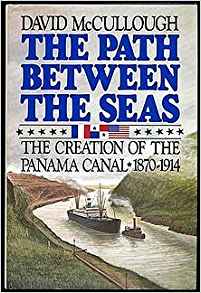
 The Path Between the Seas: The Creation of the Panama Canal 1870-1914 by David McCullough
Paperback, 698 pages. Published 1977 by Simon & Schuster. ISBN 0-671-24409-4
This book was sitting on my shelf for about 30 years. I’m pretty sure I received it as a high school graduation present. Why I never picked it up, I’m not sure, but I had a long road trip so a 700 page doorstop on conquering virgin territory seemed appropriate.
The Path Between the Seas is not McCullough’s most scintillating work. The story drags at times as he relates every meeting, legislative hearing, letter, public rally, and editorial associated with not only the successful U.S. building effort but also the failed French effort that preceded it. It reads as two separate books, and so it probably should have been.
The first half of the book, covering the French failure, manages to convey the sheer force of personality and complete lack of practical knowledge of Ferdinand de Lesseps, the builder of the Suez canal and the driver of the French debacle in Panama. De Lesseps was one of those promoters with infinite self confidence, extremely flexible ethics, and little technical knowledge to impede is great dreams. He believed that he could will the canal into existence. Because he managed to do so at Suez, he was hailed as a genius and a hero. When he failed to do so at Panama, he was reviled as a dreamer and a charlatan. Lucky for him he was too old to go to prison, so his son and other enablers did it for him.
The second half is in some ways less intriguing because no character other than Phillippe Bunau-Varilla can hope to compare to de Lesseps. Bunau-Varilla’s part in getting the U.S. into the canal game and funding the stockholders in the failed French canal company ends fairly early, and the book descends into a workmanlike history of a technical marvel. The Americans went through three chief engineers in the 11 years they worked on the canal. The first got himself fired by trying to negotiate a higher salary with Theodore Roosevelt through threats to quit. The second, John Stevens, did a far more creditable job, primarily organizing the workforce and the construction plan, but Stevens was a restless soul and pulled up stakes suddenly. At that point Roosevelt had had enough and put Army engineers in charge. Colonel George Goethals, rejected by Stevens as his deputy, became instead the chief engineer and saw the canal through to completion, ahead of schedule and under budget. Although distant and unloved, he seems to have been universally admired.
If you want a page turner, this book is not for you. If you want to know extensive details about how there came to be a trans-oceanic canal through Panama, it will serve just fine.

 James W. Vizzard